A domain is the set of inputs a function accepts. Think of a function as a rule: every allowed input must produce one output, while a single output may come from many inputs. For sine, the domain is all real numbers, ℝ; its outputs remain between −1 and 1. section 2.4.1
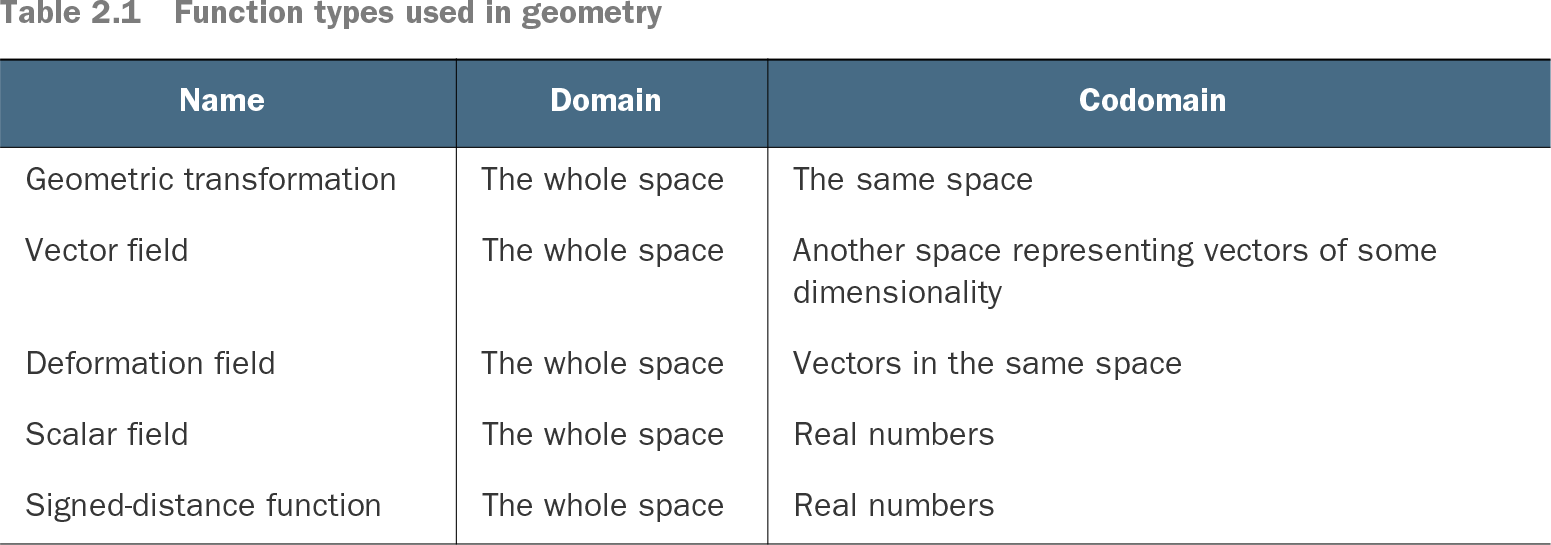
Domain and codomain together describe a function’s type, much like input and output types in programming. In geometry, this makes the role of a function concrete: a transformation maps points to points, a vector field maps points to vectors, and scalar and signed-distance fields map points to real numbers. section 2.4.2 section 2.4.3
A translation acts on space, not just a model
A 2D translation may be applied to the four vertices of a square, but its domain is all of ℝ². The rule specifies where every possible point in the plane goes, so it transforms the whole space even when only one object is drawn. section 2.4.2 section 4.1
Domains need not have the same dimensionality as outputs. A parametric surface takes a pair of parameters, conventionally (u, v), and returns a 3D point (x, y, z). This lets a 2D parameter space host a surface without requiring that it be the x-y plane. section 8.2.1
Table 2.1 Function types used in geometry (view table figure)
Compare common geometric function types by the spaces their inputs and outputs belong to. section 2.4.3