A domain concept represents meaningful business knowledge within a domain or subdomain. Relationships between concepts reveal which parts of the business should change together, helping shape cohesive domains, aligned teams, and lower-coupling software. section 9.0
Domain concepts are socio-technical: their boundaries affect code, team ownership, domain learning, business collaboration, and the speed of delivering change. There is no permanently perfect grouping because organizations, strategies, and expected changes evolve. section 9.0 section 9.2.2
Travel-company loyalty levels
A loyalty-level feature changes loyalty account, loyalty points, and rewards. Modeling these as one cohesive domain concept group lets one team change one codebase, instead of coordinating across three subdomains, codebases, and teams. section 9.1
Analyze candidate groupings by asking:
- Which concepts, business rules, and features are likely to change together? section 9.0
- Would one team reasonably own the related events and concepts? section 9.4.5
- Do particular domain experts or stakeholders care about only part of the grouping? section 9.4.5
- Mark uncertainty explicitly when concepts feel out of place, then refine the boundary through deeper domain immersion. section 9.2.2 section 9.4.5
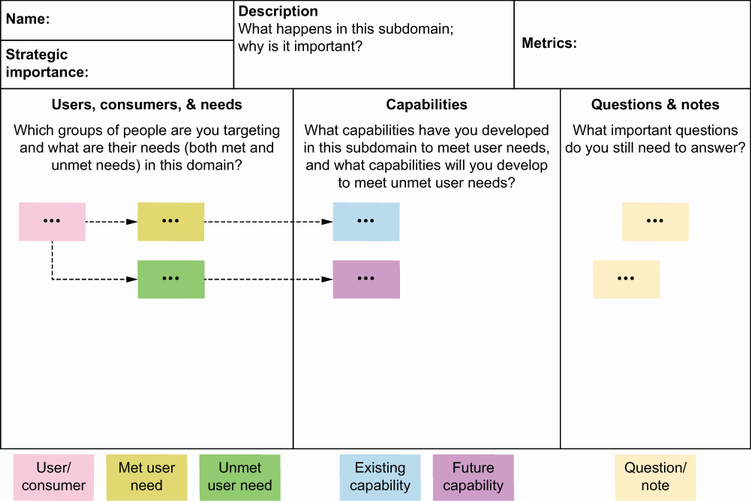
Use a subdomain overview canvas to visualize the key details of a candidate grouping while assessing its cohesion. section 9.4.5

