A domain view organizes an application’s programming elements into subdomains: slices of business functionality, each owned by a small team. It is one of the static views used to describe an application’s architecture. section 3.2 section 3.2.1
The view makes both structure and collaboration visible:
- In an object-oriented language such as Java, classes are organized into package hierarchies within subdomains. section 3.2.1
- Relationships include association and inheritance between classes, containment between classes, packages, and subdomains, and uses between subdomains. section 3.2.1
- A system operation begins in one subdomain and may use others to complete its work. section 3.2.1
Order creation in FTGO
The createOrder() operation starts in Order Management. It uses Consumer Management to check that the consumer exists and can place orders, then Delivery Management to schedule delivery. section 3.2.1
Figure 3.6 The domain view of the FTGO application, which consists of subdomains that contain the business entities that are acted up on by the application’s system operations
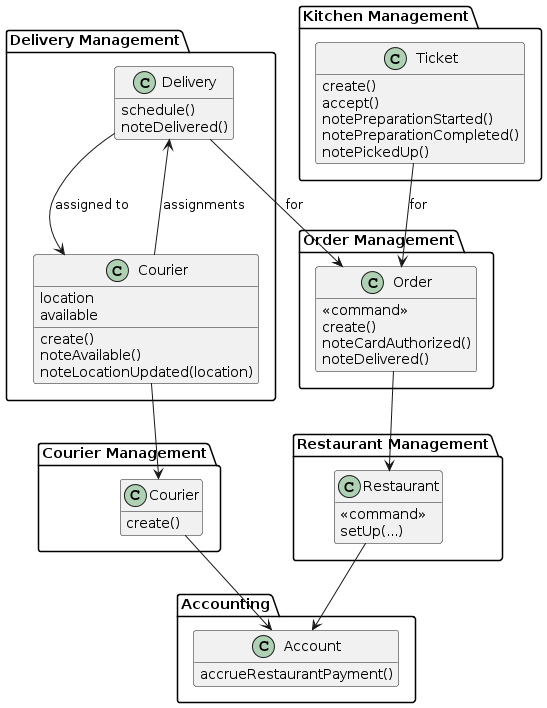
See how FTGO subdomains contain business entities and relate to the system operations that act on them. section 3.2.1
