liveBook · Manning

Drop precedence

As explained in Acing the CCNA Exam: Volume 2 Advanced Networking and Security

Drop precedence is a relative congestion-discard level indicating how likely a packet is to be dropped within an assured-forwarding class.

Drop precedence ranks packets within an assured-forwarding class by their likelihood of being discarded during congestion. Higher precedence means a greater likelihood of drop. section 10.3.3

AF encodes drop precedence as follows:

  • Uses four traffic classes, each containing three drop-precedence levels. section 10.3.3
  • Uses the five most significant DSCP bits: three identify the class and two identify drop precedence; the least significant bit is zero. section 10.3.3
  • Does not make a numerically higher AF value inherently better; AF41 has lower drop precedence than AF43 despite both belonging to class 4. section 10.3.3

Calculating AF42

Multiply the class by 8 and the drop-precedence value by 2, then add: (4 × 8) + (2 × 2) = 36, so AF42 has decimal DSCP value 36. section 10.3.3

Figure 10.14 The AF marking system. The five most significant bits are divided into the class (3 bits) and drop precedence (2 bits). The sixth bit is always 0.
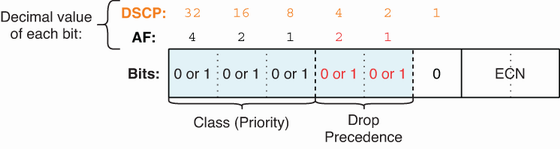
Visualizes the five-bit AF layout, including its class and drop-precedence fields and the fixed sixth bit. section 10.3.3

How Acing the CCNA Exam: Volume 2 Advanced Networking and Security covers it

How deep it goes
Defines behavior, bit encoding, valid ranges, and a decimal-value shortcut, but does not cover configuration or verification.
Examples
Uses AF42 calculation and contrasts AF41 with AF43 to show why numeric value does not determine preference.
What it assumes
Assumes familiarity with DSCP fields and QoS marking while teaching AF class and drop-precedence encoding.
What you can do after
Evaluate AF markings and calculate their decimal DSCP values from class and drop-precedence components.
How it connects
Connects DSCP marking with assured forwarding, traffic classes, congestion, and QoS.

Related concepts

This explainer was generated by Manning's knowledge graph from the text of Acing the CCNA Exam: Volume 2 Advanced Networking and Security. The section links point to the parts of the book it draws on.