Drug-likeness estimates whether a compound has physicochemical characteristics associated with oral-drug suitability. It is commonly used as an inexpensive early filter before ligand-based screening, docking, or molecular-dynamics simulations reduce a library further. section 2.1.1 section 2.3.1
A common starting point is Lipinski’s Rule of Five, which flags increased absorption risk when a molecule exceeds more than one threshold:
- Molecular weight below 500 daltons. section 2.3.1
- Calculated lipophilicity, or logP, below 5. section 2.3.1
- No more than 10 hydrogen-bond acceptors. section 2.3.1
- No more than 5 hydrogen-bond donors. section 2.3.1
These rules approximate oral bioavailability rather than proving drug quality. A violation does not automatically imply poor solubility or permeability; project-specific risk thresholds determine how strictly to apply the filter. section 2.1.1 section 2.3.1
Applying an Ro5 filter
For each compound, count violations of the four thresholds, mark it compliant when the count is at most one, and separate compliant from violated records. A library example reduces 212,670 compounds to 199,640 post-filter records. section 2.3.1
Figure 2.1 Virtual screening pipelines are often hierarchical, proceeding with a broad, large number of compounds through simpler, less restrictive, and computationally cheaper processes to whittle down the quantity of compounds. If the 3D structure of the target is not defined, we’re restricted to ligand-based virtual screening. If it is defined, then we can explore structure-based virtual screening, potentially as a downstream component to ligand-based virtual screening.
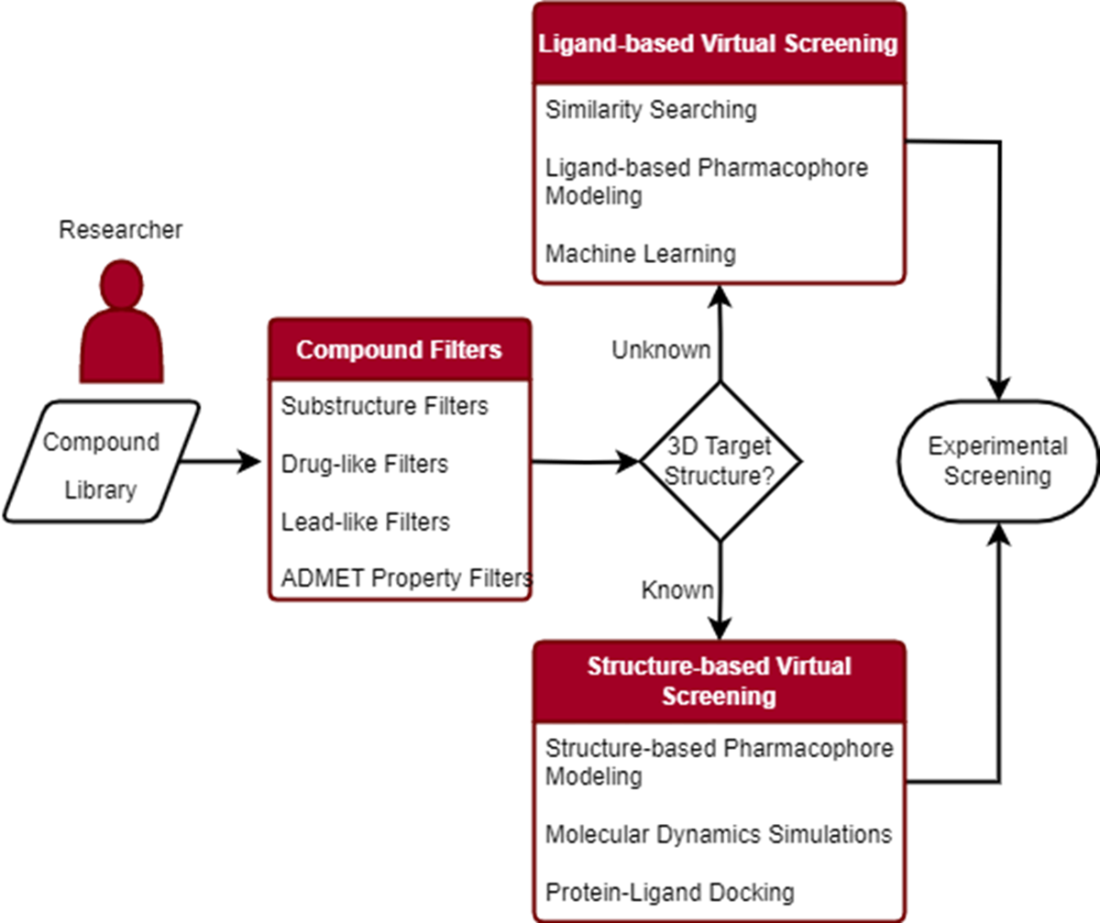
Use the hierarchical pipeline view to place drug-likeness filtering before more restrictive and computationally expensive screening stages. section 2.1.1
