Dynamic analysis examines an event processing network (EPN) during runtime, rather than analyzing only its static model. Simulation runs the application with simulated events and scenarios; tracing records and analyzes runtime executions. These methods can reveal behavior that static analysis cannot. section 10.5.2
Runtime observations can expose whether potential design issues actually occur:
- Detect a termination problem when a loop is realized in simulation or observed in a trace. section 10.5.2
- Find an EPA that appears reachable in the network but is never activated during simulation or tracing. section 10.5.2
- Identify producer or EPA outputs that no EPA or consumer uses; this may indicate that the producer can be eliminated. section 10.5.2
- Trace the provenance of an event or network node backward or forward, and observe raw and derived event quantities for optimization. section 10.5.2
Figure 10.11. An example of provenance—finding the path in the EPN that contains all the antecedents of the derived event "Shipment Delay 7 to 10 Days"
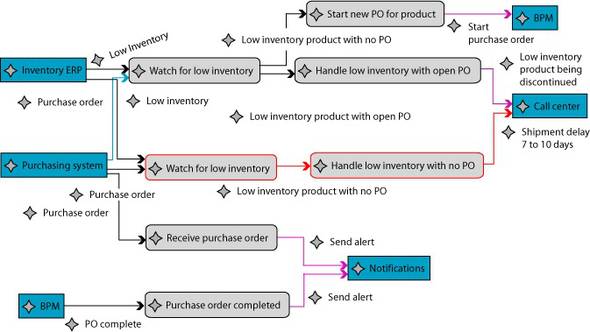
The figure traces the EPN path containing the antecedents of the derived event “Shipment Delay 7 to 10 Days.” section 10.5.2