A dynamic MAC address is learned automatically when a switch examines a received frame’s source MAC address and associates it with the receiving port. The entry tells the switch where to forward future frames for that device. Unlike a static MAC address, it is not manually configured. section 6.3.1
Dynamic entries age out after five minutes without receiving a frame from that MAC address. Use show mac address-table to view the table, or clear mac address-table dynamic to remove learned entries. section 6.6
Two-switch learning scenario
In a network with two switches and four PCs, each switch learns the PCs’ MAC addresses from frame source fields. SW1 reaches PC1 through G0/1, PC2 through G0/2, and PC3 or PC4 through G0/0; SW2 records the corresponding paths through its ports. section 6.3.1
Figure 6.3 A network with two switches, each with two PCs connected. SW1 and SW2 have learned the MAC address of each PC by examining the Source field of frames received on their ports as the PCs communicate with each other. SW1 knows it can reach PC1 via its G0/1 port, PC2 via its G0/2 port, and PC3/PC4 via its G0/0 port. SW2 knows it can reach PC1/PC2 via its G0/0 port, PC3 via its G0/1 port, and PC4 via its G0/2 port.
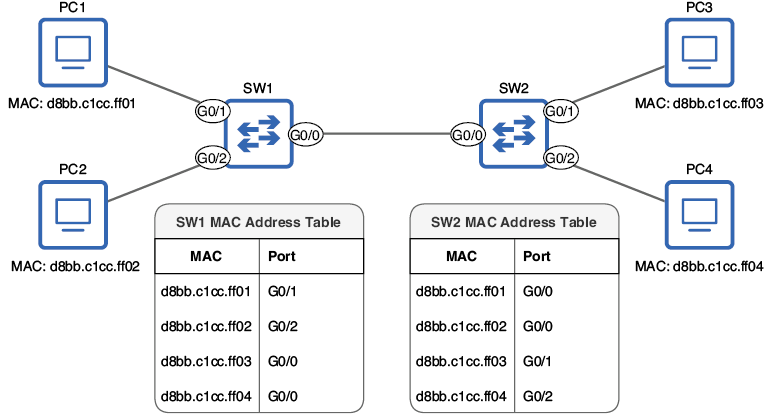
Visualizes how switches learn dynamic MAC addresses and associate each device with a local or inter-switch port. section 6.3.1

