Dynamic range is the span of magnitudes a numerical representation can encode. In fixed-point formats, allocating more bits to the integer part expands that span but reduces precision; allocating more to the fractional part does the reverse. Calibration measures activation ranges to help place the binary point. section 2.1
When one range cannot fit
A Q0.7 format clamps values such as 5.2 to 0.99, while Q7.0 rounds tiny gradients such as 0.001 to zero. Neither suits both large and small values; floating-point moves its scale with an exponent. section 2.1
Figure 2.3 The range-versus-precision tradeoff in Q-format. For a fixed 8-bit container, every bit allocated to the integer part doubles the representable range but halves the precision (step size). Moving the binary point left (more fractional bits) gives finer resolution at the cost of a narrower range; moving it right does the reverse. There is no free lunch: the total information capacity is fixed by the bit-width.
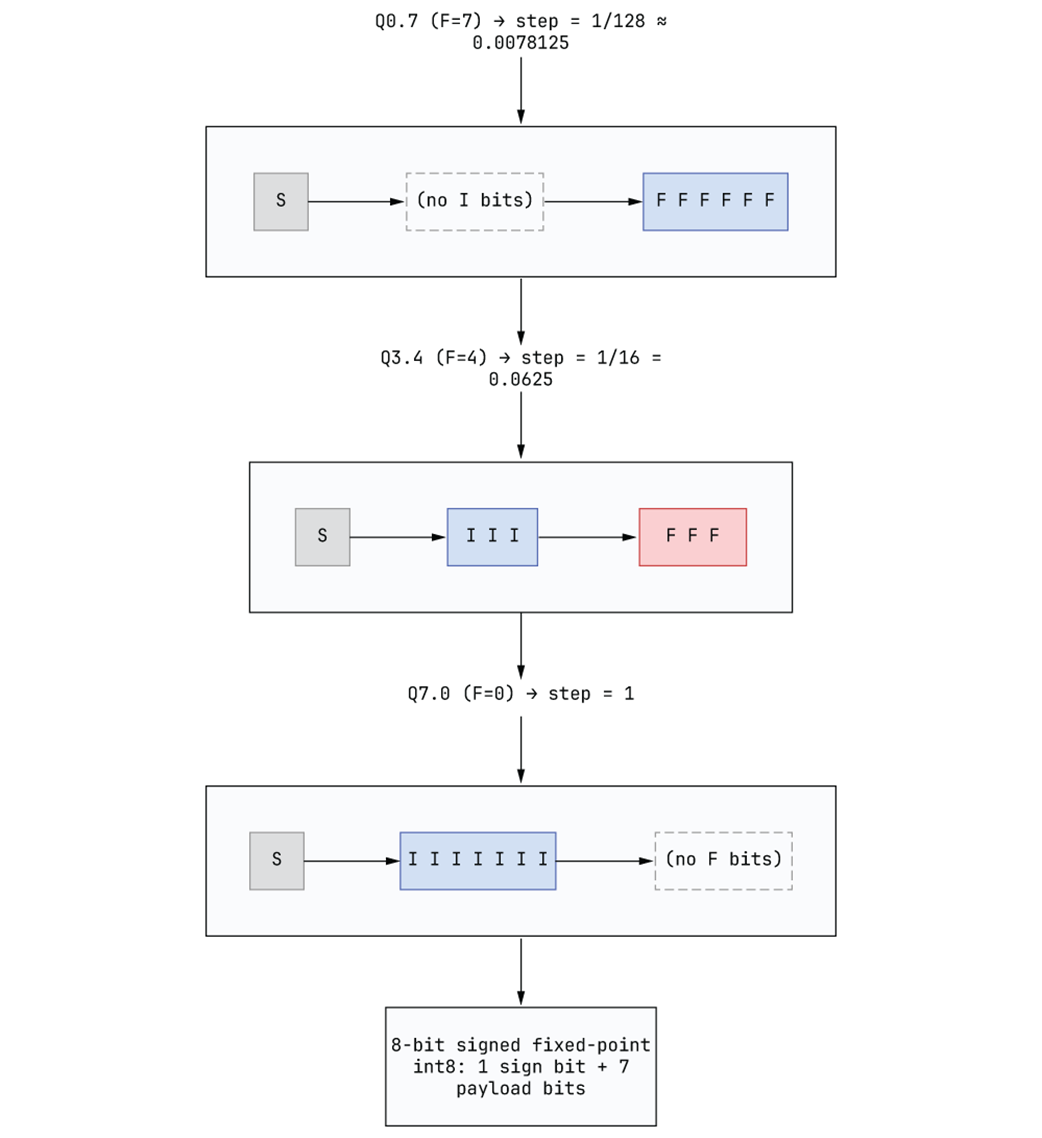
The diagram shows how reallocating bits in an 8-bit Q-format trades range for resolution. section 2.1