E4M3
E4M3 is an 8-bit floating-point format with one sign bit, four exponent bits, and three fraction bits.
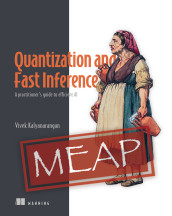
Quantization and Fast Inference
An 8-bit floating-point format with one sign bit, four exponent bits, and three mantissa bits.
- How it is used
- Deploys weights and forward-pass activations in FP8 when their values concentrate near zero.
- How deep it goes
- Defines the bit layout and range, explains scaling granularity, and specifies a matmul kernel's hardware and layout constraints.
- Examples
- Compares near-zero representable values and measures OPT-6.7B weight-only compression and perplexity.
- What you can do after
- Apply via vLLM or TensorRT-LLM to deploy FP8 weights, checking that throughput goals have H100-or-later hardware support.

Build a DeepSeek Model (From Scratch)
E4M3 is an FP8 encoding with four exponent bits and three explicitly stored mantissa bits.
- How it is used
- Deploys higher-precision FP8 arithmetic across forward and backward operations when fine-grained scaling controls local dynamic range.
- How deep it goes
- Explains bit allocation, precision–range trade-offs, and training-format selection, without detailing encoding equations.
- Examples
- Contrasts E4M3 with E5M2 and INT8, then applies it to uniformly quantized forward and backward training operations.
- What you can do after
- Evaluate FP8 format choices and apply uniform E4M3 when block-local scaling sufficiently limits outlier-driven range loss.
Read how Build a DeepSeek Model (From Scratch) explains E4M3 →
What to know first
- activationAn activation is a numerical value or tensor produced by a neural-network unit, layer, or operation during a forward computation.
- forward passA forward pass is a computation that propagates inputs through a model or dependency structure in the forward direction to calculate outputs or intermediate values.
Related concepts
- FP8kind of · FP8 is a family of 8-bit floating-point formats for representing values and performing reduced-precision computation.
- forward passuses · A forward pass is a computation that propagates inputs through a model or dependency structure in the forward direction to calculate outputs or intermediate values.
- 8-bit signed integercontrasts with · An 8-bit signed integer is a fixed-width integer representation of whole numbers from −128 through 127.
- NVFP4used by · NVFP4 is NVIDIA’s 4-bit floating-point format, which represents values in blocks using shared scaling factors.
Questions about E4M3
What is E4M3?
E4M3 is an 8-bit floating-point format with one sign bit, four exponent bits, and three fraction bits.
Which Manning books explain E4M3?
Quantization and Fast Inference and Build a DeepSeek Model (From Scratch).
What should I know before learning E4M3?
Manning books that teach E4M3 usually introduce activation and forward pass first.
What is the difference between E4M3 and E5M2?
E4M3 is an 8-bit floating-point format with one sign bit, four exponent bits, and three fraction bits. E5M2 is an 8-bit floating-point format with one sign bit, five exponent bits, and two fraction bits.
What is E4M3 a kind of?
E4M3 is a kind of FP8. FP8 is a family of 8-bit floating-point formats for representing values and performing reduced-precision computation.
These guides are generated from the text of Manning books by Manning's knowledge graph and link to the sections they draw on. The full books are available on liveBook and at manning.com.