Eager evaluation runs operations immediately instead of first assembling them into a static computation graph. In PyTorch, the Python interpreter sends each instruction to the underlying C++ or CUDA implementation as it executes. section 1.5
The execution model makes PyTorch work in a direct, step-by-step way:
- A PyTorch instruction executes as soon as the interpreter reaches it. section 1.5
- Operations on tensors are carried out by backend implementations, including C++ or CUDA code. section 1.5
- The model-development workflow can proceed directly from data loading and training toward deployment or model export. section 1.5
A tensor operation executes immediately
When a Python instruction performs an operation involving a PyTorch tensor, the corresponding computation is carried out at that point by the backend rather than waiting for a separately constructed graph. section 1.5
Figure 1.2 Basic, high-level structure of a PyTorch project, with data loading, training, and deployment to production
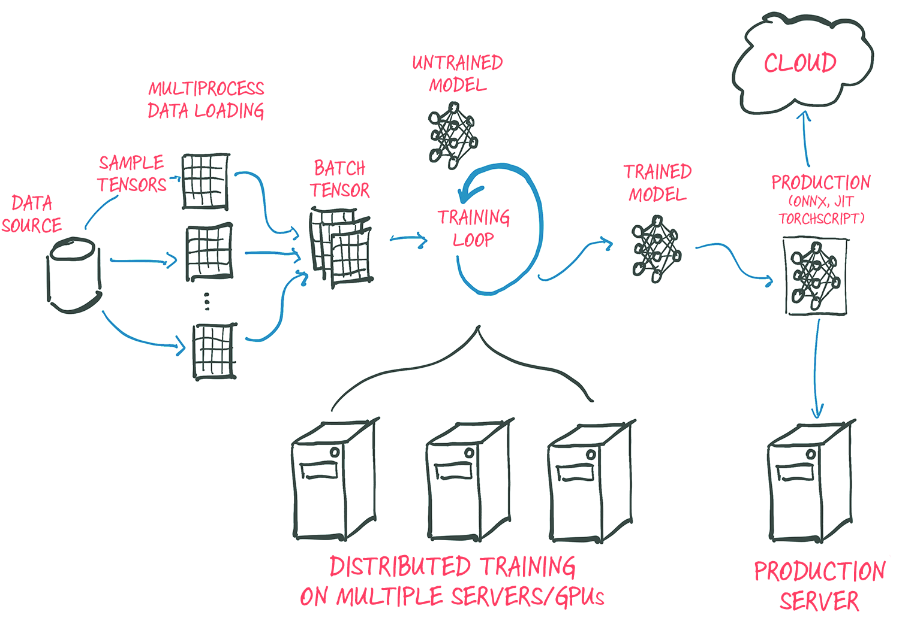
A high-level project diagram places immediate tensor computation within the larger flow from data loading and training to production deployment. section 1.5




