EAP over LANs (EAPoL) encapsulates EAP messages for transport across Ethernet or IEEE 802.11 LANs. 802.1X defines this transport as part of port-based network access control: the client must authenticate before communicating on the wired port or wireless LAN. section 20.2.2
Follow the authentication path:
- The supplicant is the client requesting network access. section 20.2.2
- The authenticator is the AP, switch, or— in a split-MAC design—the WLC that controls access. section 20.2.2
- EAPoL carries EAP between the supplicant and authenticator; RADIUS carries the EAP messages from the authenticator to the authentication server, usually a RADIUS server. section 20.2.2
Figure 20.6 The 802.1X/EAP protocol stack. 802.1X defines EAPoL, which allows EAP messages to be transported over Ethernet or 802.11 LANs.
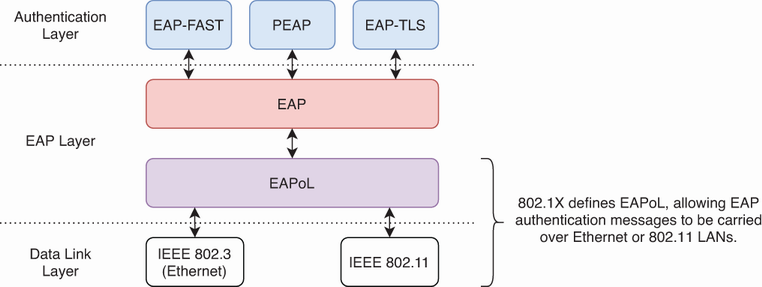
Use the protocol-stack figure to distinguish EAP authentication methods from 802.1X’s EAPoL transport function. section 20.2.2
Figure 20.7 EAPoL is used to transport EAP messages between the supplicant and authenticator, and RADIUS between the authenticator and AS.
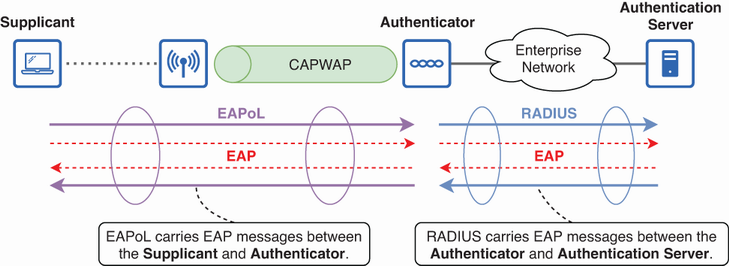
Use the message-flow figure to trace EAPoL between client and authenticator and RADIUS toward the authentication server. section 20.2.2
