liveBook · Manning

Edge point

As explained in Advanced Algorithms and Data Structures

An edge point is a non-core point that is reachable from at least two different core points or clusters.

An edge point is a non-core point reachable from at least two different core points or clusters. DBSCAN may assign it to any reachable cluster. section 12.3.2

During cluster expansion, processing an edge point adds no further points. Its final cluster therefore depends on the order in which dataset points are processed. section 12.3.2

A boundary point between clusters

With minPoints set to 4, the point w is directly reachable from two clusters associated with q and p. DBSCAN can merge w into either cluster. section 12.3.2

Figure 12.11 An edge point w is directly reachable from at least two different clusters. In this example, minPoints is set to 4; the path from q to p is highlighted with thicker arrows.
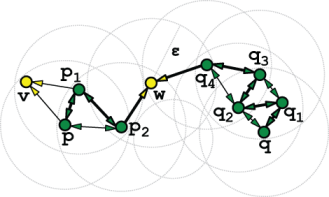
Use the diagram to inspect how one edge point is reachable from two different clusters. section 12.3.2

How Advanced Algorithms and Data Structures covers it

How deep it goes
Traces edge-point assignment through cluster expansion and processing order, but does not develop a separate data structure for edge points.
Examples
Uses point w, clusters associated with q and p, and minPoints set to 4.
What it assumes
Assumes familiarity with DBSCAN, core points, clusters, and reachability.
What you can do after
Evaluate/understand why DBSCAN may place one boundary point in different reachable clusters.
How it connects
Connects edge points to DBSCAN, core points, clusters, reachability, density, and outliers.

This explainer was generated by Manning's knowledge graph from the text of Advanced Algorithms and Data Structures. The section links point to the parts of the book it draws on.