When a feed collects updates from many friends, finding the ones that matter can mean scrolling past people you barely know. Facebook introduced EdgeRank in 2007 to rank friends’ posts by personalized relevance instead of reverse chronology. section 1.2.2
EdgeRank used straightforward weighting: newer posts and posts from people a user interacted with more often received priority. That preference could feed back on itself: seeing more updates from someone could create more chances to interact with them. Unlike later platform algorithms, EdgeRank used a simple, understandable weighting formula. section 1.2.2
Interaction and relevance
Someone who messages a friend daily might want more updates from that friend than from someone they rarely interact with; EdgeRank gave the more frequently interacted-with friend greater weight. section 1.2.2
Figure 1.3 Various social media models. In the Subscription model, the content is seen only by users who explicitly follow the content producer, with no options or resharing. In the Network model, users can also reshare content from users they follow, enabling the distribution of content outside of the immediate network. Finally, in the Algorithmic model, an algorithm can add content to users’ feeds, even with no direct connection to the content itself or its author.
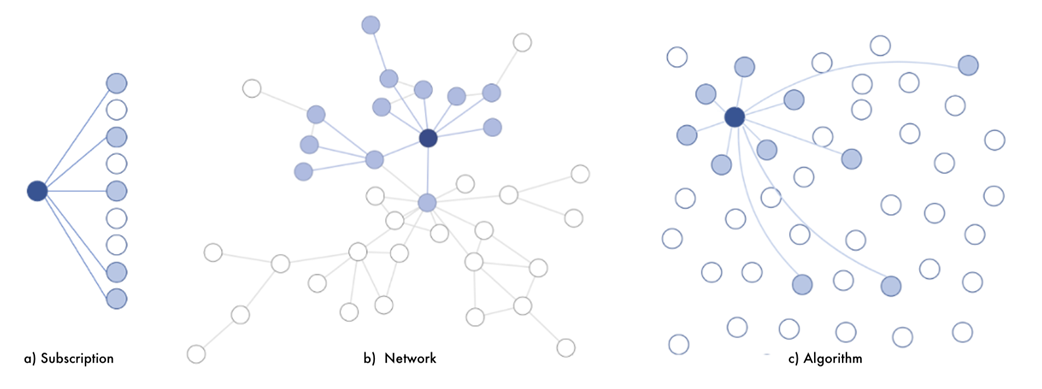
The figure contrasts subscription, network, and algorithmic feeds, placing personalized ranking in the wider shift toward algorithmically selected content. section 1.2.2
