liveBook · Manning

Edholm's law

As explained in Fast Python: High performance techniques for large datasets

An empirical observation that telecommunications data rates tend to double approximately every 18 months.

Edholm's law observes that telecommunications data rates approximately double every 18 months. Treated as a proxy for data generation, it highlights a widening mismatch between incoming data and the computing capacity available to process and store it. section 1.1

Use the observation to reason about data-processing pressure:

  • Compare data growth with Moore's law, whose roughly two-year transistor-density doubling implies a six-month lag. section 1.1
  • Treat internet traffic as an indirect measure of available data; its historical growth tracks Edholm's law. section 1.1
  • Expect processing demands to increase further as data becomes more unstructured. section 1.1
Figure 1.1 The ratio between Moore’s law and Edholm’s law suggests that hardware will always lag behind the amount of data being generated. Moreover, the gap will increase over time.
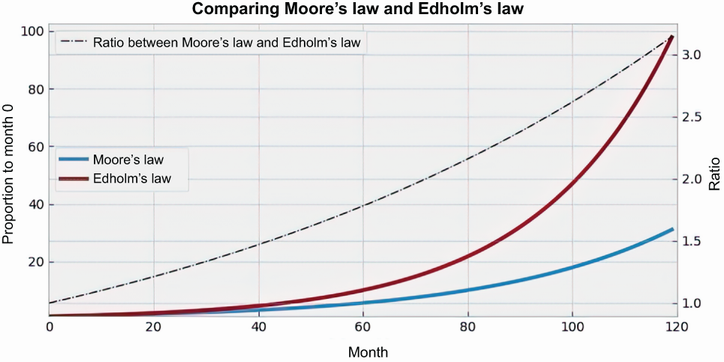
A comparison graph illustrates how data generation can outpace hardware capability and how the gap increases over time. section 1.1

How Fast Python: High performance techniques for large datasets covers it

How deep it goes
Defines the empirical growth rate and compares it with Moore's law, while deferring modern CPU-architecture details.
Examples
Uses internet-traffic growth and two comparative graphs to illustrate data expansion and hardware lag.
What you can do after
Evaluate whether processing and storage resources can keep pace with expanding data volumes.
How it connects
Connects telecommunications data rates with Moore's law, internet traffic, data processing, storage, and unstructured data.

Related concepts

This explainer was generated by Manning's knowledge graph from the text of Fast Python: High performance techniques for large datasets. The section links point to the parts of the book it draws on.