Wireless LANs use air as a communication medium: antennas convert alternating electric current into fluctuating electric and magnetic fields that radiate as electromagnetic waves. section 18.0 section 18.2
An electromagnetic wave contains electric and magnetic fields that oscillate perpendicular to each other. Its behavior is described primarily by amplitude, frequency, and period. section 18.2.1
Use these measurements to interpret wireless signals:
- Amplitude measures the maximum electric and magnetic field strength and relates to energy; higher amplitude produces a stronger signal, while insufficient amplitude can make messages indistinguishable. section 18.2.1
- Frequency measures oscillations per second in hertz: kHz represents thousands, MHz millions, GHz billions, and THz trillions. section 18.2.1
- Period measures the time required for one complete oscillation; a 4 Hz wave has a 0.25-second period. section 18.2.1
Frequency affects propagation and wireless LAN performance. Higher frequencies can support higher data rates and encounter less device crowding but are more readily absorbed by obstacles; lower frequencies penetrate obstacles better and cover greater distances. section 18.2.1
Account for these operational effects when assessing wireless coverage:
- Free-space path loss weakens signals as they propagate; receivers eventually cannot decode signals that become too weak. section 18.5
- Absorption converts wave energy into heat, while reflection, refraction, diffraction, and scattering alter the wave’s path or distribution. section 18.5
- Interference can come from neighboring wireless LANs, microwave ovens, cordless phones, and Bluetooth devices; wireless devices use CSMA/CA to avoid collisions. section 18.5
Reading a 4 Hz Wave
A frequency of 4 Hz means four complete oscillations occur each second. Each oscillation therefore lasts 0.25 seconds. section 18.2.1
Figure 18.5 Waves with higher amplitude carry stronger signals, indicated by greater electric and magnetic field strengths.
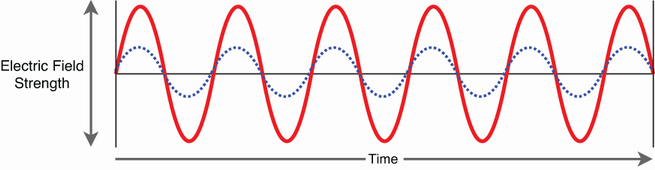
Use the amplitude comparison to distinguish stronger and weaker electromagnetic signals by their field strengths. section 18.2.1
