liveBook · Manning

Element extraction

As explained in Retrieval Augmented Generation, The Foundational Ideas

Element extraction is the identification of entities and relationships in text to produce structured graph data.

Element extraction converts text chunks into structured entities and relationships for graph construction. An LLM identifies people, places, concepts, and their connections, producing subject–predicate–object triplets. section 12.1.1

A practical extraction pipeline:

  • Split source documents into manageable text windows. section 12.1.1
  • Prompt an LLM to extract entities, relationships, and structured triplets from each chunk. section 12.1.1
  • Preserve character offsets so extracted claims remain grounded and citable. section 12.1.1
  • Load the triplets into a graph library or database such as NetworkX, igraph, Neo4j, ArangoDB, or TigerGraph. section 12.1.1
Figure 12.2 The same corpus and the same query, run through both workflows.
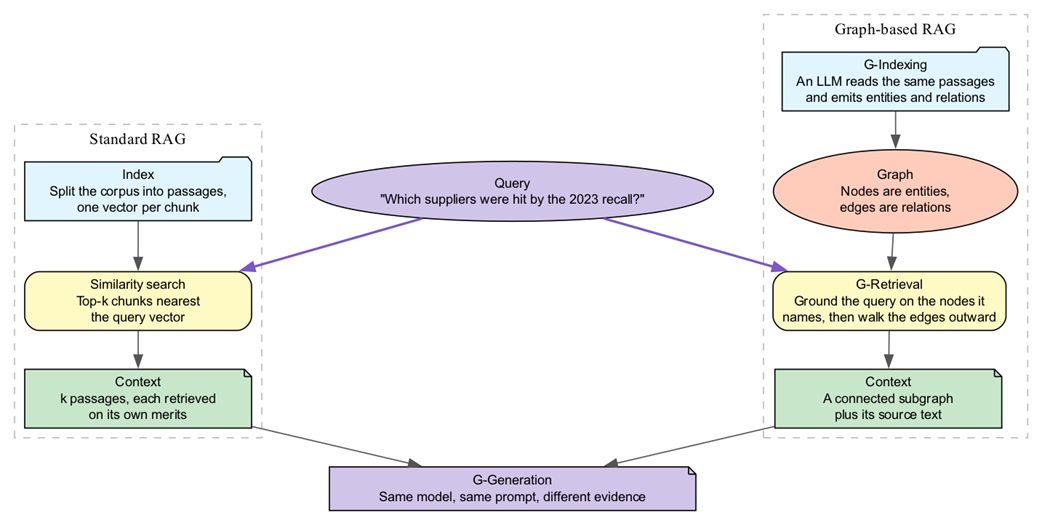
Compare how the same corpus and query flow through chunk retrieval versus connected-subgraph retrieval. section 12.1.1

How Retrieval Augmented Generation, The Foundational Ideas covers it

How deep it goes
Explains extraction within a three-step indexing pipeline and emphasizes provenance, but does not detail prompt design or entity resolution.
Examples
Uses subject–predicate–object triplets, character offsets, LangExtract, NetworkX, igraph, Neo4j, ArangoDB, and TigerGraph.
What it assumes
Assumes familiarity with document chunking and LLMs while defining entities, relationships, triplets, and graph indexing.
What you can do after
Build it from source chunks into provenance-aware triplets and load those triplets into a graph structure.
How it connects
Connects chunking, graph construction, knowledge graphs, graph databases, and graph-based RAG.

This explainer was generated by Manning's knowledge graph from the text of Retrieval Augmented Generation, The Foundational Ideas. The section links point to the parts of the book it draws on.