A genetic algorithm can lose its best solution when it replaces an entire population through mating and mutation. Elitism prevents that loss: copy one or a few highest-fitness individuals directly into the next generation, without changing them. The remaining places can be filled through the usual selection and variation steps. section 18.1.6
When deciding whether to use elitism:
- Keep the selected individuals unaltered. Their survival ensures that the population’s best fitness does not decline across generations, though a newly created individual may surpass them. section 18.1.6
- Do not expect the population’s average fitness to improve automatically. Excessive crossover or mutation can worsen many of the other individuals, especially when solutions are already strong. section 18.2.4
- Distinguish elitism from thresholding: elitism carries high-fitness individuals forward unchanged; thresholding prevents low-fitness individuals from being selected for mating. section 18.1.6
Two optimization settings
In a 0–1 knapsack population, the highest-fitness candidate can pass to the next generation without mating or mutation. In traveling-salesperson experiments, retaining elites did not prevent high rates of crossover and mutation from producing worse solutions on average; whether elitism helps remains problem-dependent. section 18.1.6 section 18.2.4
Figure 18.6 Elitism and thresholding illustrated with an example (0-1 knapsack problem). Elitism takes the best individual(s) (one or a few of the highest-fitness entries) and directly brings them to the next generation without mating or mutations. Thresholding takes care of the opposite problem: it’s a hard barrier that stops low-fitness individuals from passing their genes to the next generation. It’s possible to discard a certain fixed number of individuals, or all individuals below some threshold. For instance, in this example (where we maximize fitness value), all individuals below 80% of the fitness value of the best individual will be discarded and never selected for mating.
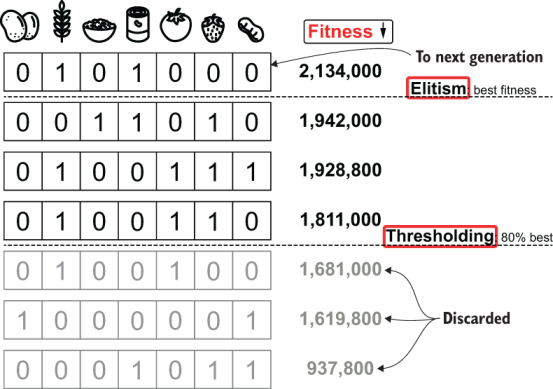
The knapsack diagram contrasts the unchanged transfer of top individuals with a fitness threshold that excludes low-fitness individuals from mating. section 18.1.6

