When a feed needs recommendations, it can compare a user’s embedding with item embeddings and serve items that are closest. This ranks content by distance, but fast searches can miss relevant items in favor of less relevant ones. section 2.7
Figure 2.11 When representing users and items with a single number, they can be thought of as points on a line. The recommendations will be ordered by their distance on the line. In this case, the User is represented with a 0.8; therefore, the items will be ordered as Item 3, Item 2, Item 1.

A line of points shows how distance orders recommendations when each user and item has a single number. section 2.7
Figure 2.12 Two-dimensional representation of users’ and items' embeddings. We represent users and items as two numbers: one for cat affinity and one for dog affinity. Such numbers can also be used as coordinates to represent them on the plane. User A has a high affinity for both animals, so they are in the top-right corner, while user B is neutral and close to the center. The items recommended for them are those that minimize the distance to their respective embeddings.
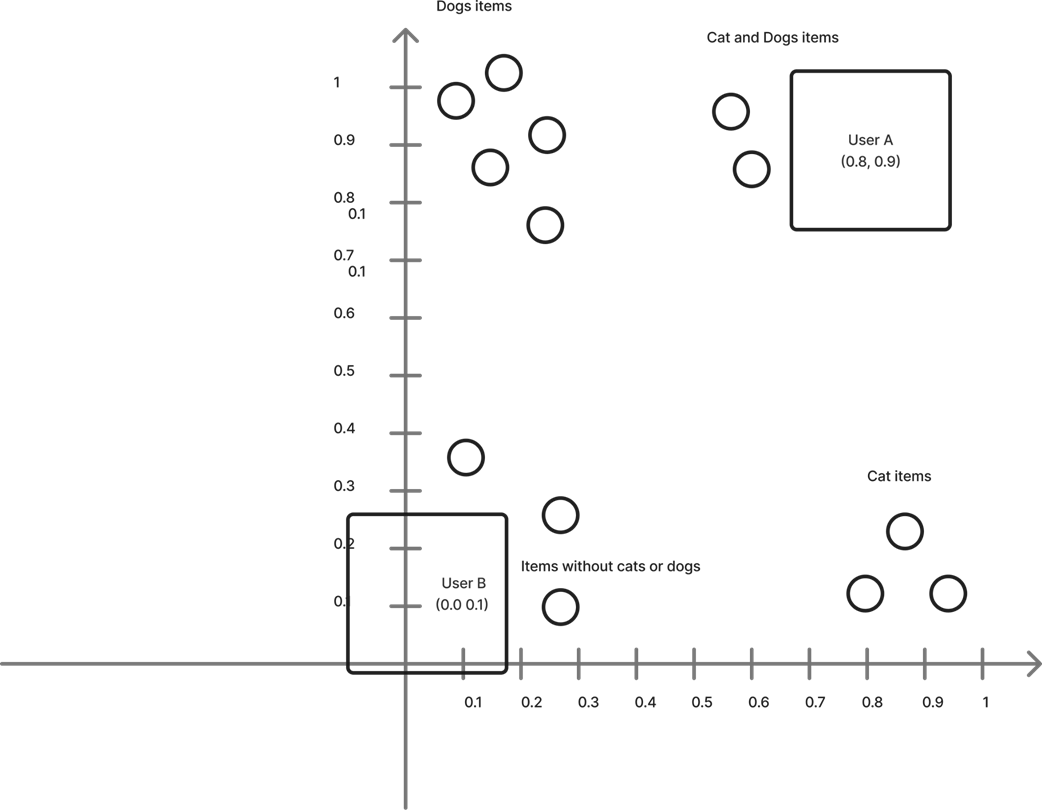
Cat and dog affinity coordinates show how the closest items can differ for users with different interests. section 2.7
