Emergent behavior is a collective pattern or capability that arises when many simple individuals interact. A single ant or bird may seem limited, yet a group can coordinate, adapt, and solve problems through local interactions. section 6.1 section 7.1
The individuals do not need a central commander. Ants change behavior after sensing pheromones, while birds adjust their movement in response to nearby flock members. Repeated local choices can produce organized group behavior. section 6.1 section 7.1
Common patterns of emergent behavior include:
- Ants create trails and coordinate colony tasks, including finding food and building bridges. section 6.1
- Birds flock through alignment with neighbors, cohesion toward the group, and correction when individuals drift away. section 7.1
- Swarm intelligence algorithms imitate these collective patterns to address difficult problems. section 6.1 section 7.1
Why ants find the shorter path
Suppose ants can choose between a short bridge and a long bridge. Ants using the short bridge complete trips more quickly, so they lay down pheromones twice as often per minute. The stronger trail attracts more ants, reinforcing the shorter route. In the observed experiment, the colony converged on that path after eight minutes. section 6.1
Figure 6.1 A group of ants working together to cross a chasm
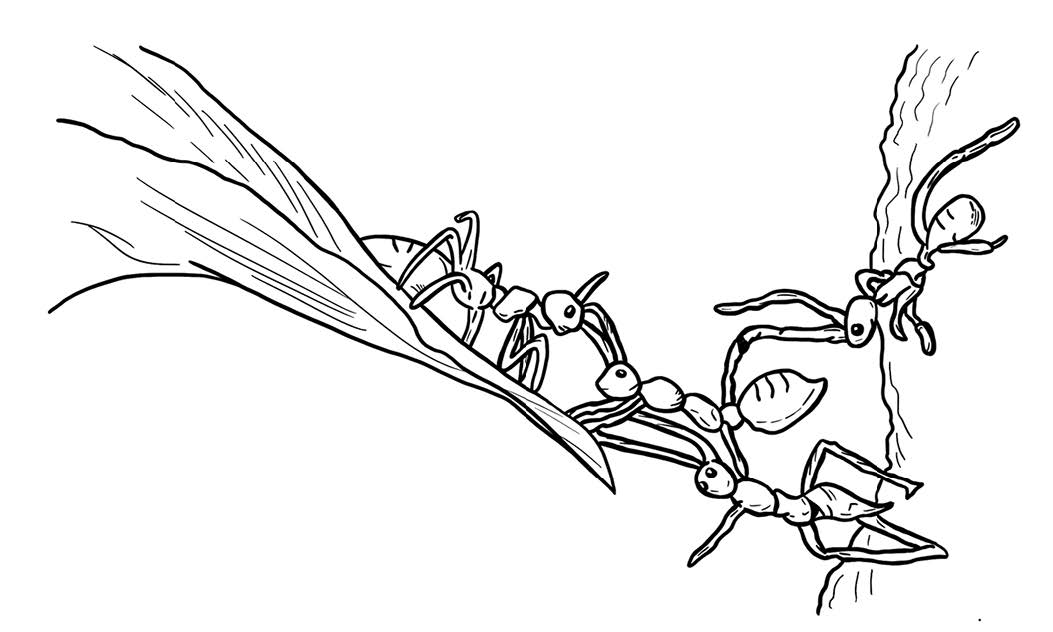
View ants working together to form a bridge, a concrete illustration of individuals producing a useful group structure. section 6.1
Figure 7.2 Rules that guide a swarm
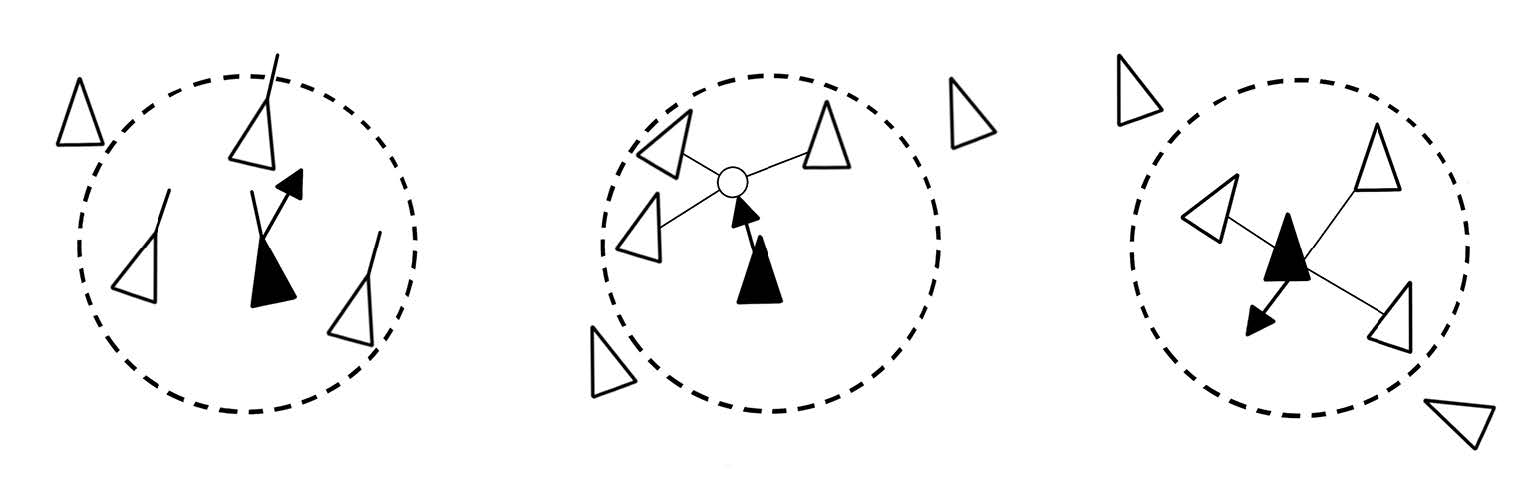
Review the simple rules that guide a swarm and connect individual adjustments with coordinated group motion. section 7.1




