An enabler creates conditions that help participants achieve a collaborative modeling session’s goals and make inclusive decisions. The facilitator removes roadblocks affecting individuals or the group rather than owning the outcome. section 5.1.2 section 5.9
This stance requires noticing participation patterns and returning observations to the group without taking control. A climate report can make behaviors visible, such as some participants staying silent while others talk over one another, so the group can improve its flow. section 5.1.2
Handing EventStorming back to the group
During Big Picture EventStorming, begin by modeling stakeholder interactions, swimlanes, and pivotal events. Then shift responsibility to participants: invite them to add a pivotal event and remind them to phrase it in the past tense. The facilitator removes obstacles while participants lead the work. section 5.1.2
Use the enabler stance to:
- Observe who is participating and what is blocking progress. section 5.1.2
- Name observed dynamics so participants can respond to them themselves. section 5.1.2
- Keep responsibility for the session’s outcome with the group. section 5.9
Figure 5.1 The facilitator takes on different stances. The observer stance takes a central place, which provides a facilitator with important information to take on other stances.
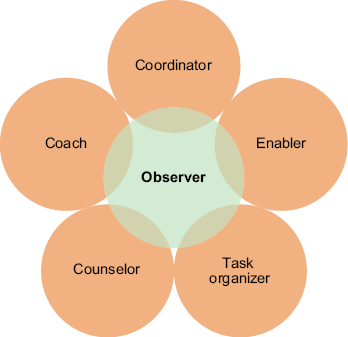
Use the stance map to relate enabling to observing, coordinating, coaching, counseling, and task organizing; observation provides information for the other stances. section 5.1
