An enabling constraint is a productive limitation that helps a group overcome stagnation and continue collaborative discovery. Facilitators use constraints to keep information and insights moving without forcing the session to follow a rigid plan. section 4.5 section 4.1.2
Use enabling constraints to:
- Structure collaboration when a group becomes too large, divided, biased, or unable to make sustainable decisions. section 4.5
- Move exploratory modeling toward convergence, where participants summarize discoveries, choose what to explore next, and plan next steps. section 4.1.2
- Support dialogue without treating the constraint as a rigid rule that overrides where the group’s discovery needs to go. section 4.1.2
Conversation on four feet
To manage polarity, ask one participant to state a position, clarify it through active listening, and have others stand either with or opposite that person. Invite someone on the opposing side to speak, while preventing direct replies. This limitation makes participants understand the statement before taking a position. Allow people who do not want the spotlight to move with the majority, then stop after roughly 10–15 minutes and ask for observations. section 10.3.2
Figure 10.11 Conversation on four feet starts with Step 1, in which one participant gives out a statement. Then, the group moves to Step 2, where either they agree and stand with the person giving the statement, or they disagree. At that point, the facilitator turns to someone disagreeing to give another statement. Eventually, you can see the group polarize.
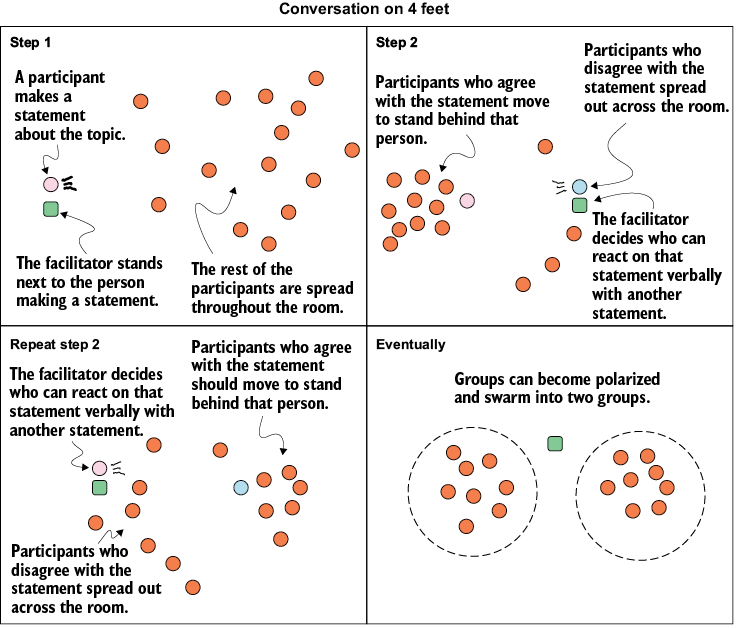
Follow the movement from an initial statement through agreement, disagreement, and eventual polarization. section 10.3.2
