An enantiomer is one of two stereoisomers that are non-superimposable mirror images. Chirality commonly arises when a tetrahedral carbon has four different substituents, creating two spatial arrangements. section 1.2.1
Thalidomide
R-thalidomide produced the intended therapeutic effect, while S-thalidomide caused severe birth defects. The case requires caution: rapid racemization in the body interconverts the two forms, so isolating the supposedly safe enantiomer would not have prevented harm. section 1.2.1
Figure 1.3 Example pairs of isomeric SMILES.
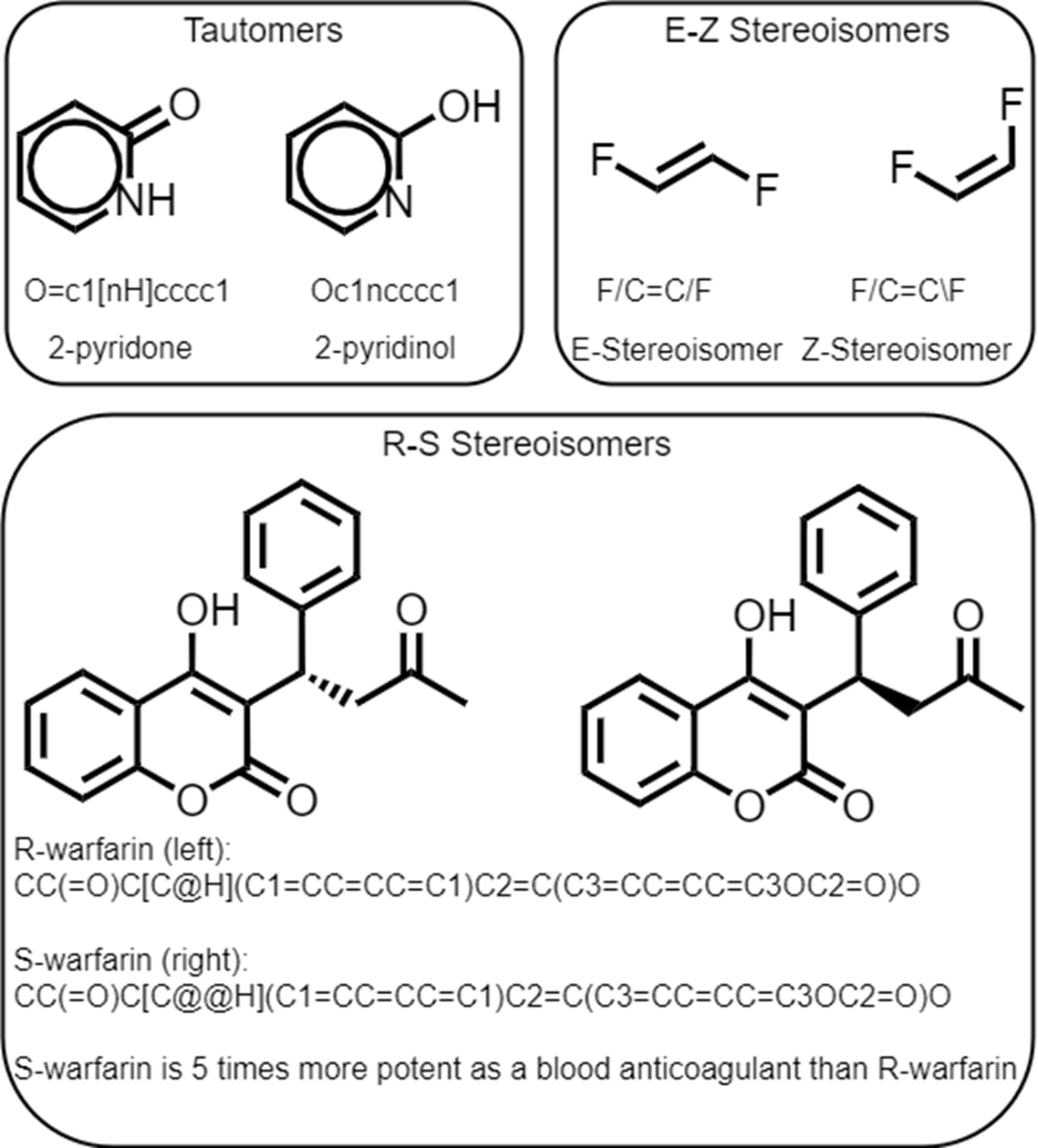
Compare paired molecular structures with their isomeric SMILES to see how stereochemical information distinguishes enantiomers. section 1.2.1
