Encryption in transit protects data while it crosses networks or moves between devices by preserving confidentiality and integrity against interception or modification, including man-in-the-middle attacks. section 20.5.1
Atlas applies this protection through several operational controls:
- Automatically secures all connections to MongoDB clusters with TLS, including traffic between Atlas cluster nodes. section 20.5.1
- Enables TLS by default and does not allow it to be disabled; TLS 1.2 is the recommended default, with a minimum 128-bit key length. section 20.5.1
- Uses OpenSSL FIPS Object Module practices for key generation, distribution, storage, replacement, and compromise response. section 20.5.1
- Assigns customers responsibility for configuring network connectivity and selected security settings, while MongoDB continuously enforces encryption controls. section 20.1
Atlas cluster communication
A client sending customer data to an Atlas cluster and nodes exchanging data within that cluster communicate over TLS-encrypted channels, while the cluster uses its selected TLS version and managed certificate and key controls. section 20.5.1
Figure 20.1 The shared responsibility model in Atlas divides security and operational tasks among customers, MongoDB, and the underlying cloud providers (AWS, GCP, and Azure). (Image © MongoDB 2024 CC BY-NC-SA 3.0)
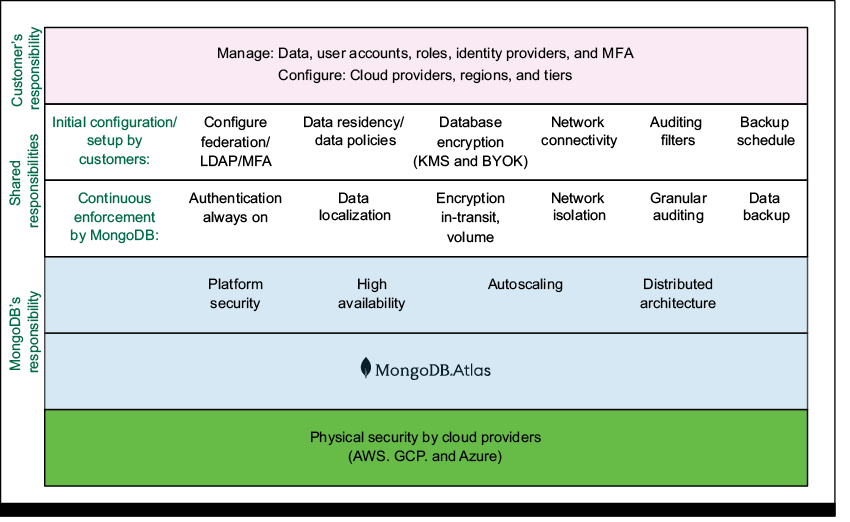
Use the shared responsibility diagram to distinguish customer-controlled connectivity and security configuration from MongoDB and cloud-provider responsibilities. section 20.1
