An entity component manager (ECM) stores and manages the entities and components that make up a simulated robot world. Entities may represent models, sensors, actuators, or lights; components hold properties such as names, poses, geometry, mass, and color. Plugin systems read and update these components. section 5.4
A simulation step uses the ECM as shared state:
- Systems write requested physics effects to entity components. section 5.4
- The physics engine computes the resulting world state and writes it back. section 5.4
- Systems read the resulting state during post-update processing. section 5.4
Server and GUI ECMs
Gazebo maintains separate ECMs for its headless server and GUI client. The transport layer synchronizes them, allowing the GUI to run on another machine. section 5.4
Figure 5.10 The Gazebo simulator has a modular architecture built around an Entity Component System (ECS), separating the headless simulation server from the graphical client while synchronizing entities, components, and plugin systems through the Gazebo transport layer. [7]
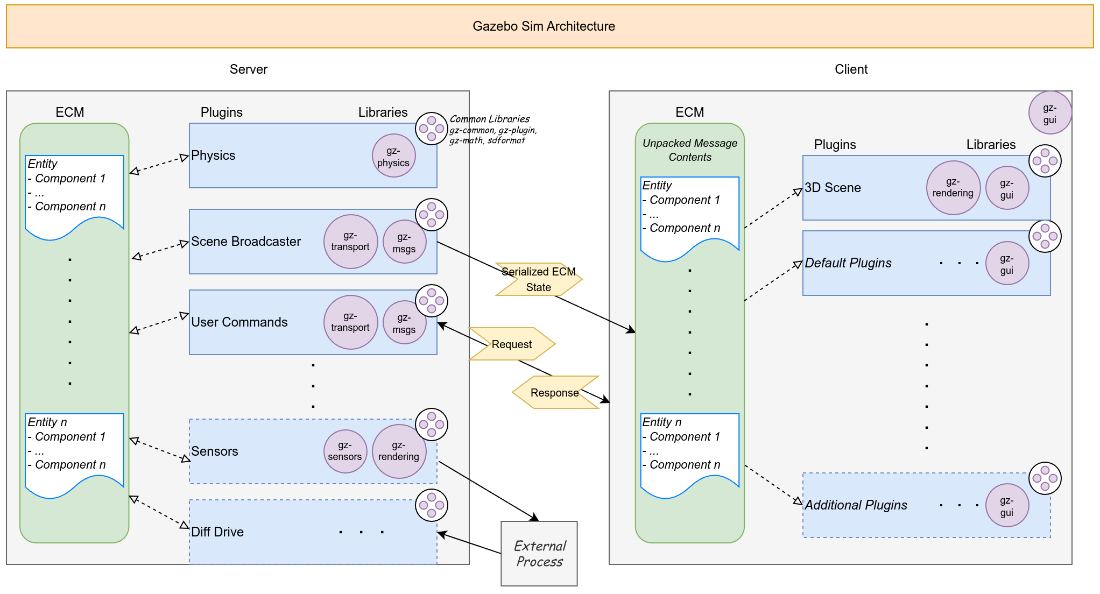
The architecture diagram connects the ECM to ECS entities, components, plugin systems, the simulation server, GUI client, and transport layer. section 5.4
