Entity linking connects a named-entity mention in text to the corresponding identifier in a knowledge base. It resolves ambiguity such as distinguishing two people with the same name and enables external data enrichment. section 12.2.1 section 12.6
A practical linking workflow typically involves:
- Identify entities using named entity recognition or an information extraction pipeline. section 12.4.4 section 12.6
- Search a target knowledge base such as WikiData, Wikipedia, DBpedia, or a biomedical resource. section 12.2.1 section 12.6
- Select the correct identifier while handling aliases, abbreviations, ambiguous names, missing entries, and insufficient context. section 12.2.1 section 12.4.4
A basic WikiData lookup
A Python function can call the WikiData API, search an extracted entity, and return the first result's URL and description. For example, Steve Jobs maps to Q19837, while an entity without a WikiData entry returns None. Choosing the first result is a useful initial implementation, but ignoring sentence context can incorrectly link an ambiguous name or phrase. section 12.4.4
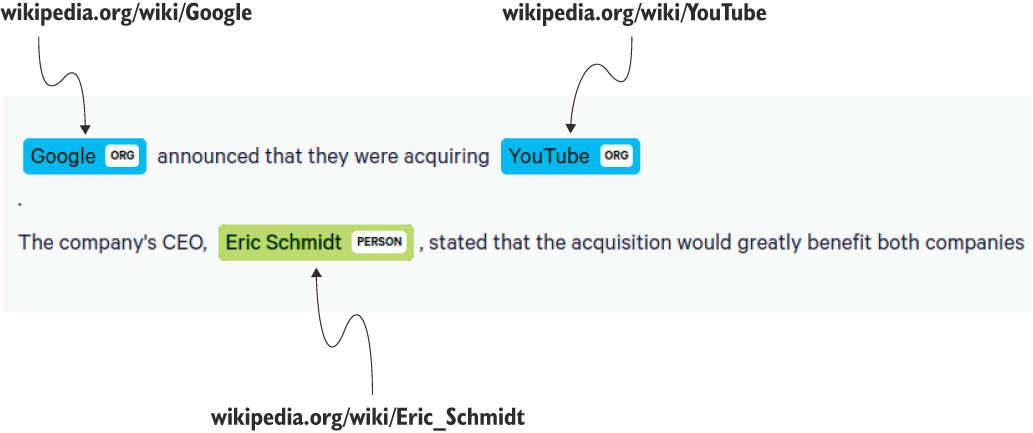
Use the named-entity linking figure to follow how mentions become links to knowledge-base entities. section 12.2.1
