Entropy is a thermodynamic quantity related to how many microscopic configurations can produce a macroscopic state, and to how energy and matter are dispersed. In a closed system, the second law says entropy never decreases. It is often described as increasing disorder, as when ice melts. section 8.1
Cream mixing into coffee makes the distinction between entropy and complexity visible. Two clean layers become swirling filaments, then a uniform beige mixture. Entropy rises throughout, but visible structure—and estimated complexity—peaks during the intermediate swirls and fades as the mixture becomes uniform. section 8.1 section 8.1.2
In the simulation, entropy is estimated by compressing the fine-grained state. Complexity is estimated separately, after coarse-graining the state to retain large patterns such as swirls. These measures capture different features: a high-entropy mixture can be uniform and visually bland. section 8.1.1 section 8.1.2
Figure 8.1 (left) low entropy and low complexity; (middle) medium entropy and high complexity; and (right) high entropy and low complexity. Used with permission granted by the lead author (Scott Aaronson).
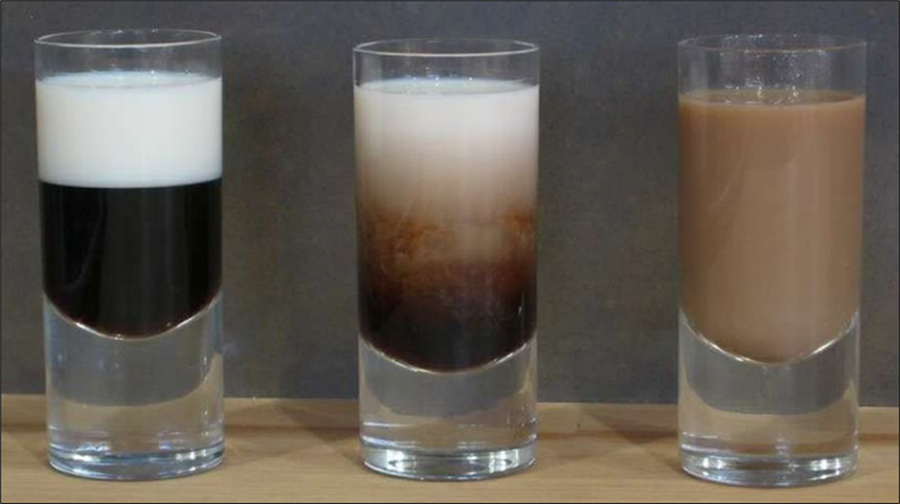
The diagram contrasts low entropy and low complexity at the start, intermediate entropy and high complexity during mixing, and high entropy with low complexity at the end. section 8.1












