Entropy search chooses the next costly observation for how much it is expected to reduce uncertainty about a target. Rather than sampling where an objective merely looks high or uncertain, it compares the possible outcomes of each action, averages their posterior entropies, and selects the action with the greatest expected entropy reduction. This makes information gain the decision rule. section 6.0 section 6.1.2
The target depends on the problem. To find a lost object, uncertainty concerns its location. In Bayesian optimization, the natural target is the optimizer x*, the input location at which a black-box objective f is maximal. A Gaussian process belief over f induces a probability distribution over x*, so an experiment is valuable when it sharpens that distribution. section 6.2.1 section 6.2
Apply entropy search as a decision procedure:
- Represent the current uncertainty about the quantity of interest with a probability distribution. section 6.1.2
- For each candidate action, consider the posterior distribution for every possible result. section 6.1.2
- Compute the expected posterior entropy by averaging across those results. section 6.1.2
- Choose the action with the lowest expected posterior entropy, equivalently the greatest expected reduction in uncertainty. section 6.1.2 section 6.4
Why binary search checks the middle
For a target in a sorted 100-element list with a uniform prior over positions, inspecting the middle divides the remaining possibilities into two equally sized cases. It minimizes expected posterior entropy, explaining binary search as an information-theoretic policy rather than just a halving trick. A nonuniform prior can instead shift the best query away from the middle, as in choosing phone-drop floors from an exponential belief about the highest safe floor. section 6.1.3 section 6.3.1
Figure 6.9 Expected posterior entropy in the location of the target as a function of the location within the list to inspect. The middle location is optimal, minimizing the expected entropy.
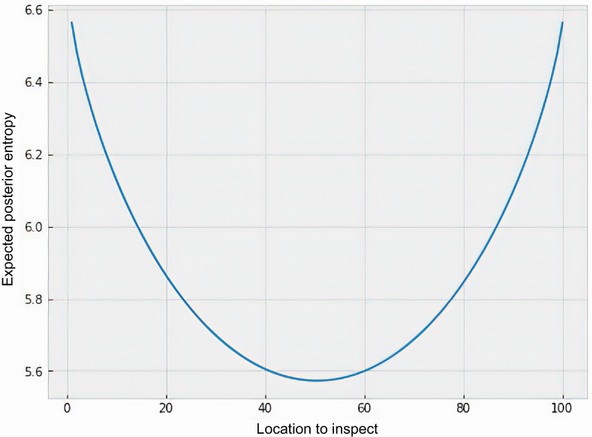
Compare expected posterior entropy across candidate list positions: the middle position is optimal under a uniform prior. section 6.1.3
Directly reducing uncertainty about x* is difficult. The optimizer distribution can be non-Gaussian and multimodal, and estimating it requires exponentially more samples as dimensionality grows. Max-value Entropy Search (MES) instead targets the optimal value f*, whose distribution is always one-dimensional. MES approximates acquisition scores with samples rather than a closed-form computation; a Sobol sequence supports sampling during policy initialization. section 6.2.1 section 6.4
Entropy search therefore emphasizes exploration that resolves the question that matters: where the optimum is, or in MES, what value it attains. It is a generic procedure for sequential decisions under uncertainty, but its BayesOpt form trades a direct optimizer-location objective for a more tractable optimal-value objective when dimensionality makes the former expensive. section 6.0 section 6.4
