liveBook · Manning

Environment promotion

As explained in Grokking Software Architecture

A software delivery practice that advances the same built artifact through a sequence of increasingly production-like environments.

Environment promotion moves one verified container artifact through increasingly production-like environments. Build it once, record its SHA, and deploy that same image rather than rebuilding “identical” copies that can drift. Each environment adds real-world checks that isolated tests cannot provide. section 13.7

Think of the environments as a runway of trust-building checks:

  • Start locally, where syntax, fakes, and isolated logic tests check the code’s intent—but not whether it can survive in a network. section 13.7
  • Promote the same artifact into isolated environments with increasingly complex network constraints, scaling parameters, and live data configurations. section 13.7
Figure 13.11 The Staging Dilemma: Traditional staging often promises perfect parity, but in reality, it frequently drifts from production, offering a false sense of security.
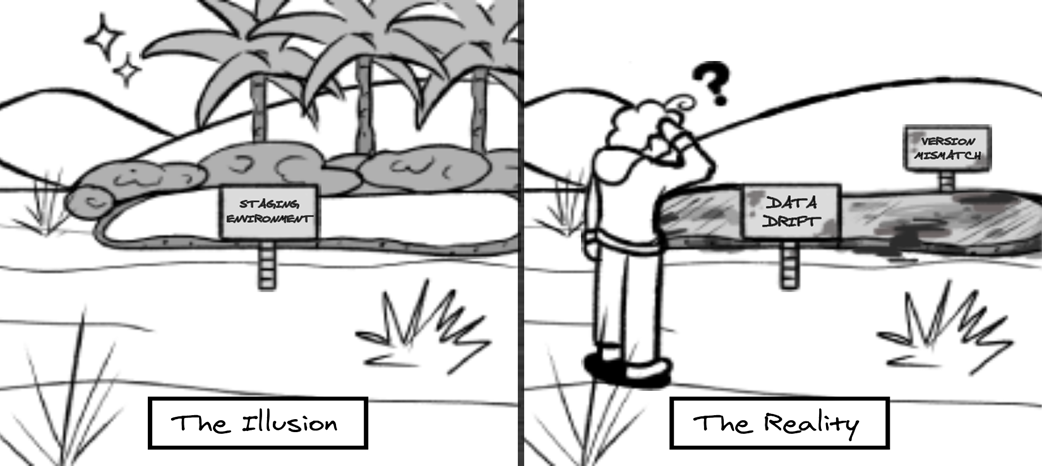
The staging dilemma illustrates how a staging environment can drift from production and offer false confidence. section 13.7

How Grokking Software Architecture covers it

How deep it goes
Explains building once, tracking the artifact’s SHA, and promoting it through environments with increasingly realistic constraints.
Examples
Uses local laptop tests with fakes and isolated logic loops, plus a staging-parity dilemma.
What you can do after
Apply the practice by building one container image, recording its SHA, and deploying that same artifact across environments.
How it connects
Connects CI/CD, automated validation gates, container artifacts, configuration drift, and non-functional requirements.

Related concepts

This explainer was generated by Manning's knowledge graph from the text of Grokking Software Architecture. The section links point to the parts of the book it draws on.