An environment signal evaluates an agent’s output using evidence from the external world, not a supplied correct answer or the model’s own opinion. It is part of the signal family used to measure the gap between an output and a desired result. section 1.4.1
External evidence can include:
- A unit test that passes or fails. section 1.4.1
- A tool call that returns successfully or errors. section 1.4.1
- Web evidence that confirms or contradicts a claim. section 1.4.1
When available, ground-truth and environment signals are preferred because they rely on something outside the model’s own opinion. Their limitation is supply: many tasks lack a clean outcome to check. section 1.4.1
Figure 1.9 The signal family arranged by precision against availability. Ground-truth and environment signals are the most precise but the rarest; judge-based signals are available almost everywhere but are noisier, and process and reflection signals assess how the agent worked rather than only what it produced.
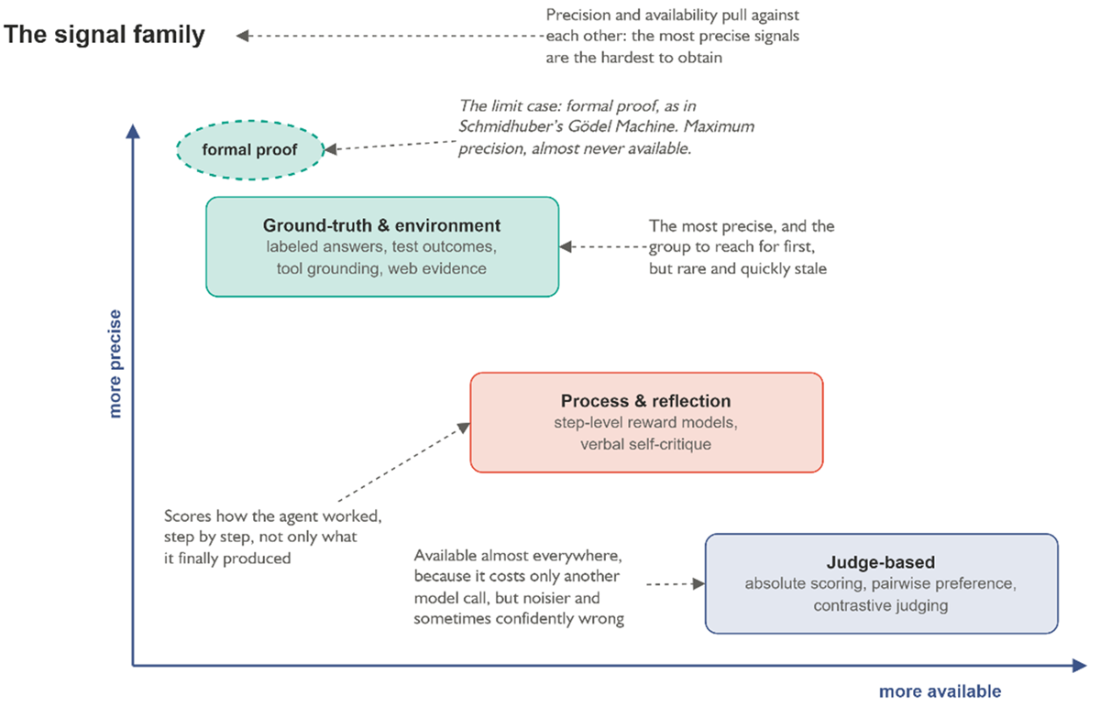
Compare environment signals with other signal types by their precision and availability. section 1.4.1