liveBook · Manning

Ephemeral port

As explained in Acing the CCNA Exam: Volume 1 Fundamentals and Protocols

An ephemeral port is a port numbered from 49152 through 65535 that is commonly used as a client source port and does not require registration.

An ephemeral port is a dynamically selected client source port numbered 49152 through 65535. IANA does not control these ports, so registration is unnecessary. section 22.1.1

Use ephemeral ports to understand connection endpoints and session tracking:

  • A client selects an ephemeral source port when connecting to a server’s destination port. section 22.1.1
  • TCP and UDP use port numbers to address application processes; source and destination IP addresses plus ports distinguish sessions. section 22.3
  • Remember the range: well-known ports are 0–1023, registered ports are 1024–49151, and ephemeral ports are 49152–65535. section 22.1.1

Client-to-server exchange

PC1 sends a TCP segment from source port 50000 to SRV1 on destination port 443. SRV1 replies from port 443 to port 50000. section 22.1.1

Figure 22.2 PC1 sends a TCP segment to SRV1. The segment is sourced from port 50000 on PC1 and destined for port 443 on SRV1. SRV1’s reply reverses the ports: it is sourced from port 443 on SRV1 and destined for port 50000 on PC1.
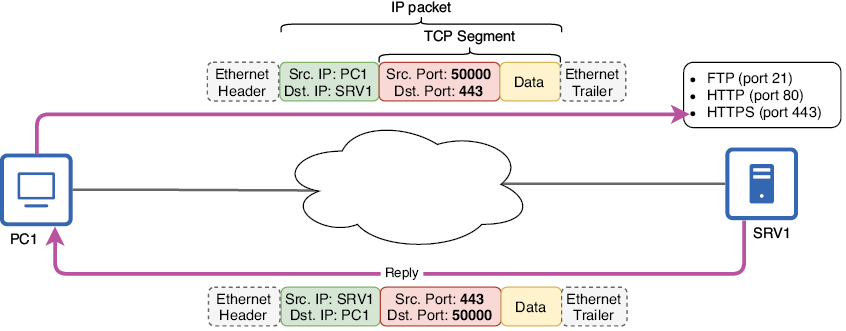
Trace how an ephemeral client source port becomes the destination port for the server’s reply. section 22.1.1

How Acing the CCNA Exam: Volume 1 Fundamentals and Protocols covers it

How deep it goes
Defines the range and role, then demonstrates endpoint reversal without detailing operating-system port-selection algorithms.
Examples
Uses PC1 port 50000 connecting to SRV1 port 443, with the reply reversing the source and destination ports.
What it assumes
Assumes basic client-server communication while defining port addressing and the three port ranges.
What you can do after
Evaluate connection endpoints by distinguishing dynamically selected client source ports from server destination ports.
How it connects
Connects ephemeral ports with port numbers, client devices, source ports, TCP, UDP, and session multiplexing.

Related concepts

This explainer was generated by Manning's knowledge graph from the text of Acing the CCNA Exam: Volume 1 Fundamentals and Protocols. The section links point to the parts of the book it draws on.