liveBook · Manning

Epsilon algorithm

As explained in Delivering Machine Learning Projects: From design to deployment

An epsilon algorithm is a bandit strategy that selects the currently best alternative most of the time and explores another alternative with a specified probability.

The epsilon algorithm is a simple bandit strategy for online model evaluation: track each alternative, select the current best most of the time, and reserve a specified probability for exploration. section 8.2.6

Implement it with an explicit exploration policy:

  • Set ε to 0.9, select the best-performing model 90% of the time, and select another model for exploratory testing 10% of the time. section 8.2.6
  • Refine the policy by requiring several trials before setting ε to 1, or decay it after each trial, such as ε′ = 0.99 × ε. section 8.2.6
  • Use the results to identify the more successful model, but do not treat them as a precise estimate of how much better it is. section 8.2.6
Figure 8.2 Three one-arm bandits with pay-out records, where each block represents one pull. A light record indicates a zero reward, and a dark one indicates a positive reward. Machine A pays frequently, Machine B pays occasionally, and Machine C never pays.
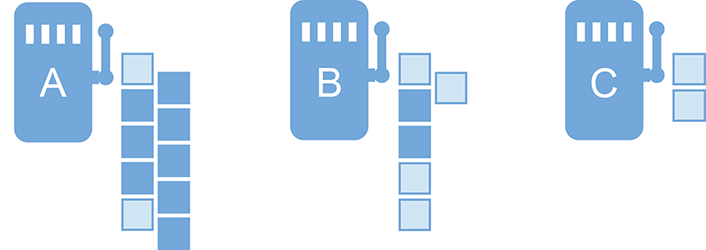
Compare alternatives through payout records: frequent rewards indicate a stronger candidate, occasional rewards indicate uncertainty, and no rewards indicate poor performance. section 8.2.6

How Delivering Machine Learning Projects: From design to deployment covers it

How deep it goes
Defines selection probabilities and practical refinements, but stops short of detailed bandit theory or statistical quantification.
Examples
Uses a 90/10 selection rule, epsilon decay, and payout records from machines with frequent, occasional, or zero rewards.
What it assumes
Assumes candidate models and a measurable performance signal, including feedback that may only indirectly indicate success.
What you can do after
Apply it to compare candidate models online while limiting experiments with poorly performing alternatives.
How it connects
Connects bandits with online evaluation, model selection, A/B testing, and fresh-test-set evaluation.

Related concepts

This explainer was generated by Manning's knowledge graph from the text of Delivering Machine Learning Projects: From design to deployment. The section links point to the parts of the book it draws on.