Equitable access means giving people fair opportunities to obtain and use a resource or service, even when their circumstances differ. In generative AI education, access includes more than making a tool available: infrastructure, wealth, language, region, and institutional support can shape who benefits. section 6.8
Generative AI can widen access to learning by lowering barriers and supporting new forms of educational assistance. It can also deepen existing disparities when wealthier school districts adopt tools faster because they have stronger digital infrastructure and more resources. section 6.8
More equitable access depends on several forms of inclusion:
- Infrastructure: learners need practical access to the systems and connectivity required to use AI tools. section 6.8
- Economic inclusion: targeted programs can reach low-income families who may otherwise be excluded. section 6.8
- Linguistic and cultural inclusion: models should support diverse languages and cultural contexts rather than serving only dominant groups. section 6.8
- Policy inclusion: institutions need transparent rules and ethical guidance instead of relying only on bans or enforcement. section 6.8 section 6.12
Reaching learners through WhatsApp
Rocket Learning used WhatsApp to deliver AI-powered educational content to millions of low-income families in India, illustrating how an inclusion-focused delivery channel can expand learning access. section 6.8
Figure 6.8 Examples of how educators and students can integrate generative AI tools in the classroom
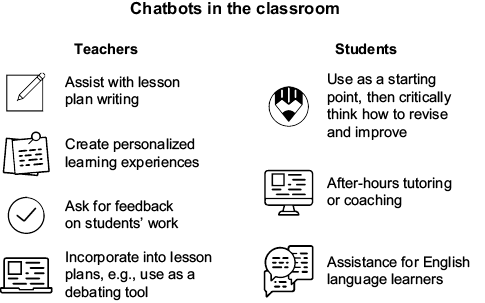
Classroom integration examples help connect equitable access with the practical ways educators and students may use generative AI. section 6.8
