liveBook · Manning

Symmetric traveling salesman problem

As explained in Optimization Algorithms: AI techniques for design, planning, and control problems

A traveling salesman problem in which cities are points in a Euclidean plane and travel costs are symmetric distances.

The symmetric traveling salesman problem (STSP) asks for the shortest round trip through every city exactly once. Cities are points in a Euclidean plane, and distance is identical in either direction, so the route forms an undirected graph. section 2.1.1 section 11.5

A regional delivery loop

For 13 major cities in the Greater Toronto Area, a planner must choose one complete loop and optimize distance, time, or another cost. The permutation search space grows factorially, making naive enumeration impractical. section 2.1.1

Figure 2.2 TSP in the Greater Toronto Area (GTA). The traveling salesman must visit all 13 cities and wishes to select the “best” path, whether that be based on distance, time, or some other criterion.
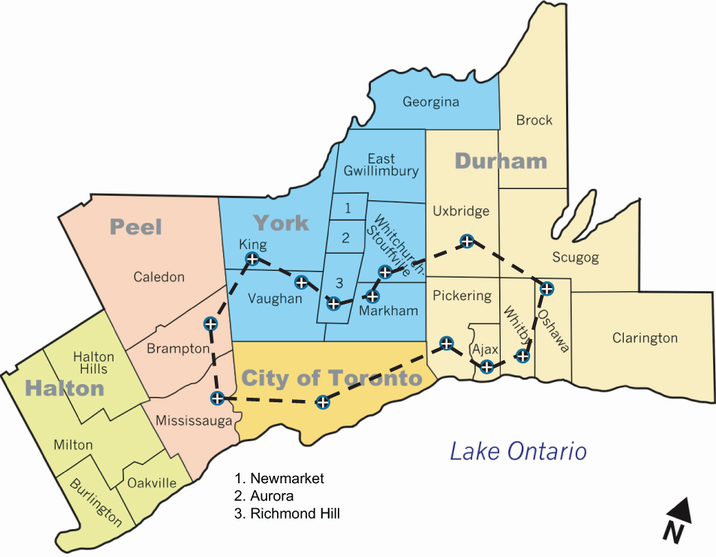
Use the regional map to visualize cities as points and compare candidate round trips against the chosen cost criterion. section 2.1.1

Common solution directions include:

  • Dynamic programming reduces the search burden by solving smaller subproblems; Bellman–Held–Karp has O(2^n × n²) complexity. section 2.1.1
  • Exact and approximate alternatives include Concorde, branch and bound, Christofides, 2-opt, and 3-opt. section 2.1.1
  • Machine learning can generate tours directly, configure optimization parameters, or repeatedly guide decisions during optimization. section 11.5

How Optimization Algorithms: AI techniques for design, planning, and control problems covers it

How deep it goes
Defines the permutation search space, contrasts exact and approximate methods, and stops short of implementing a solver.
Examples
Uses a 13-city Greater Toronto Area tour and Euclidean planar points as concrete routing examples.
What it assumes
Assumes basic combinatorics and optimization vocabulary while introducing permutations, graph symmetry, and search-space growth.
What you can do after
Evaluate/understand why naive tour enumeration scales poorly and compare dynamic, heuristic, exact, and learning-based approaches.
How it connects
Connects combinatorial optimization with dynamic programming, heuristics, asymmetric TSP, graph theory, and machine learning.

Related concepts

This explainer was generated by Manning's knowledge graph from the text of Optimization Algorithms: AI techniques for design, planning, and control problems. The section links point to the parts of the book it draws on.