A scenario is a concrete situation describing what can happen when a particular action is performed under specified conditions. Working with scenarios exposes details and coupling that remain hidden in abstract designs. section 12.2.1
Scenarios support iterative exploration at several scales, from an individual subdomain model to multiple subdomains collaborating in an end-to-end flow. Repeatedly walking through them reduces missed details and can justify a code spike when the conceptual model needs verification. section 12.2.1
Use scenarios to make collaborative modeling more specific:
- Select an action and identify the event it normally triggers. section 7.4.1
- Generate alternative situations and edge cases, including cases that change the expected outcome. section 7.4.1
- Place scenarios between the action and resulting event, then split out a concept when its situations become substantial enough to deserve focused treatment. section 7.4.1
Order cancellation
The Cancel Order action normally produces an Order Canceled event. If the order has already left the warehouse and the customer requests a refund, the scenario instead produces Cancellation Denied. This contrast reveals a business rule that a high-level timeline could miss. section 7.4.1
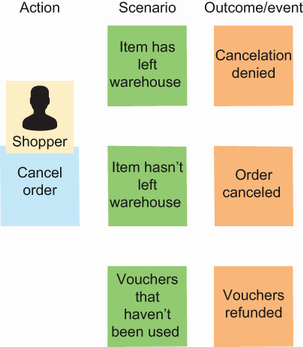
Use the EventStorming-flavored Example Mapping figure to inspect how actions, scenarios, and resulting events are arranged for collaborative analysis. section 7.4.1


