The evaluation triad evaluates retrieval-augmented generation through three independent relationships among the query, retrieved context, and generated response: faithfulness, answer relevance, and context relevance. It requires no ground-truth answers, so it can assess previously unseen queries. section 14.2
Use each dimension to isolate a different failure point:
- Context relevance detects retrieval problems by asking whether the retrieved material helps answer the query. section 14.2
- Faithfulness detects generation hallucinations by testing whether the response stays supported by the retrieved context. section 14.2
- Answer relevance detects extraction and specificity failures by testing whether the response addresses the query. section 14.2
A reranker regression
A mortgage compliance assistant improved retrieval after adding a cross-encoder reranker, but faithfulness fell as answers drifted from their supporting documents. Comparing the triad across releases exposes this regression instead of relying on a single threshold. section 14.0
Figure 14.3 The RAGAS evaluation triad.
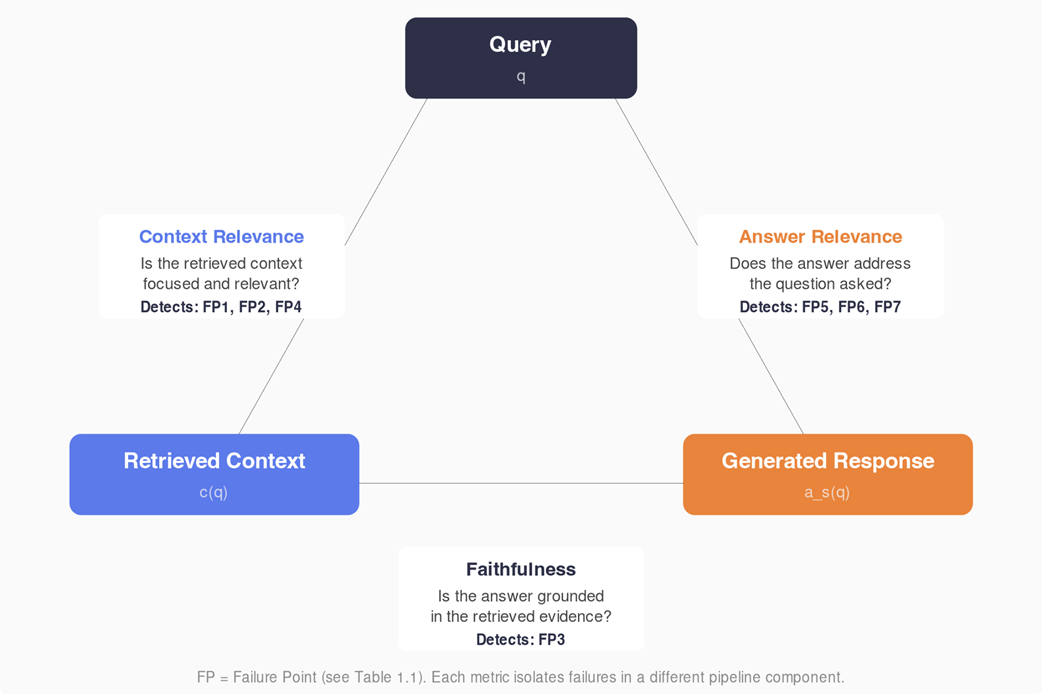
The triad diagram maps each metric to one relationship among the query, retrieved context, and generated response. section 14.2
