An event is information—something observed or discovered—that helps update a probability. Start with a prior, the estimate based on little information; use the event to calculate a posterior, a revised estimate. section 8.1
A word in an email
Suppose 20 emails contain “lottery”: 15 are spam and 5 are not. Finding that an email contains the word is the event; among those emails, the estimated probability of spam is 15/20, or 0.75. section 8.2
Figure 8.3 The prior, the event, and the posterior. The prior is the “raw” probability, namely, the probability we calculate when we know very little. The event is the information that we obtain, which will help us refine our calculation of the probability. The posterior is the “cooked” probability, or the much more accurate probability that we calculate when we have more information.
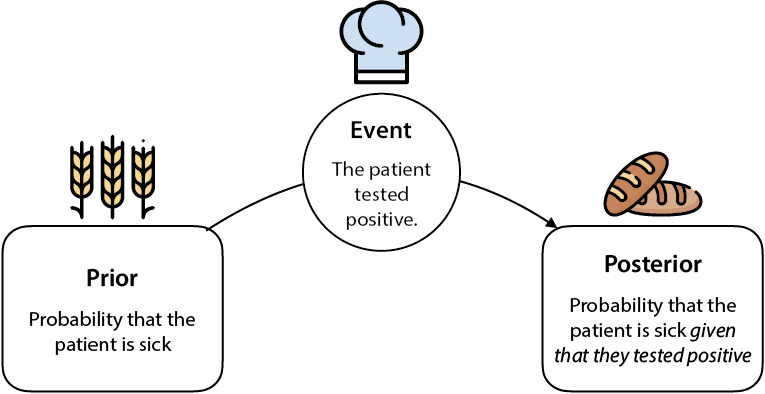
The diagram connects the prior, event, and posterior as successive parts of an updated probability estimate. section 8.1
