Eventual consistency allows replicas or views of distributed storage to differ temporarily while updates propagate. New or updated objects may not appear immediately in directory listings or across regions, creating higher and more variable access behavior than colocated storage. section 5.2.2 section 5.4
Designing around eventual consistency requires:
- Accounting for delayed listings and overwrites when building ingestion pipelines, commit workflows, and cleanup jobs. section 5.4.3
- Using Iceberg’s commit protocol, atomic catalog pointer updates, and metadata file tracking to mitigate consistency hazards. section 5.2.2 section 5.4.3
- Monitoring latency and consistency behavior when commit frequency or real-time ingestion is high. section 5.4.3
Amazon S3 with Apache Iceberg
An Iceberg table stored in S3 may encounter delayed visibility for listings or overwrites. Iceberg metadata and catalog pointer updates help coordinate safe concurrent reads and writes, but pipelines still need consistency-aware workflows and monitoring. section 5.4.3
Figure 5.6 Files are stored as blobs (binary large objects) alongside an object that holds the metadata and ID used to access them. A user requests a file by key, and the system uses the metadata to locate and retrieve it.
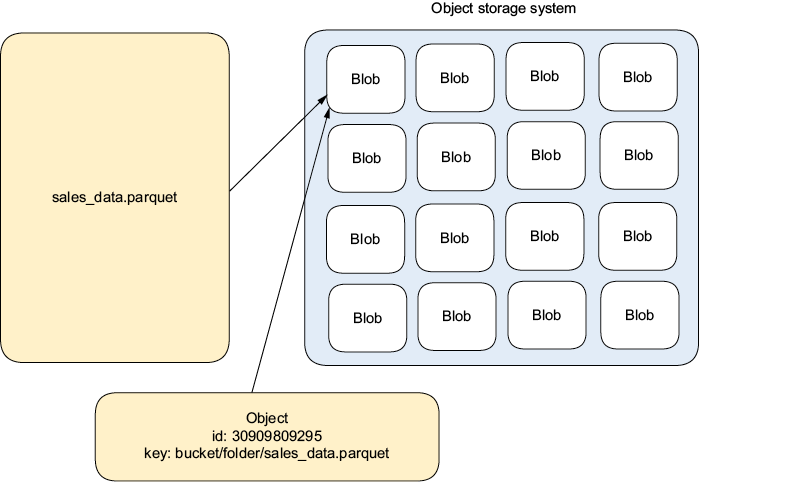
Use the object-key retrieval diagram to relate delayed object visibility to the metadata and blob layers used by object storage. section 5.2.2





