An evolutionary approach modernizes systems and organizations in valuable slices rather than defining a complete target state and following a rigid, multiyear transition plan. The overall journey may take years, but the first improvements can arrive within three to six months. Discovery, architecture design, and delivery continue in parallel: what teams learn while delivering one slice can change the next architectural decision or roadmap priority. section 1.3
Make the approach practical by treating plans as decisions to revisit:
- Assess modernization opportunities by subdomain. Some justify rethinking user experience, business processes, functionality, and the domain model; others do not warrant that investment. section 1.3
- Prioritize and sequence slices by expected business value, then check whether each investment delivers sufficient return and progress. section 1.3 section 16.0
- Validate ideas on a small scale before extending them. Keep the strategy and roadmap open to changes prompted by delivery and feedback. section 16.0
Start where value and constraint meet
An airline chose booking as its first modernization slice because it was central to payments and business flow, yet coupling made scaling and new business rules difficult. Stability improved after modernization. The work also exposed previously unknown features and edge cases in the old monolith, creating unplanned migration work and challenging proposed domain boundaries. The lesson is not to perfect the domain model before starting, but to revise it as evidence emerges. section 9.3.4
Evolve the organization as well as the system
A European telecom company had already tried a generic move from Waterfall to a Spotify-style operating model, but large teams and dependencies still slowed product enhancements. It formed an internal exploration team of business and technology representatives, with an external coach, to examine options suited to its context. Wardley Mapping, Value Stream Mapping, and Team Topologies supported conversations about bottlenecks and change without making the organization dependent on the coach. section 15.2
Figure 1.11 Architecture modernization is parallel streams of work (not phases) supported by continuous learning and upskilling.
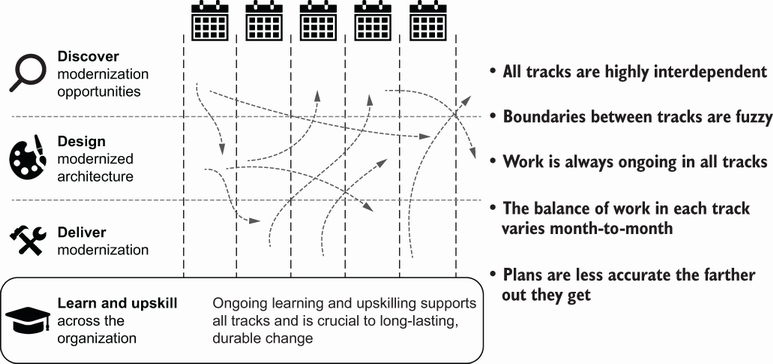
Use the parallel-streams view to discuss which areas are ready for delivery now, which still need discovery, and how learning in either stream could redirect the other. section 1.3
