Evolvability is the ease and speed of changing an application’s technology stack. It is a form of modifiability, but stack upgrades deserve separate attention: they can cut across subdomains and teams, and vulnerabilities can make them urgent even when customer requirements have not changed. section 5.3
High evolvability supports fast flow by making technology decisions and implementation less dependent on coordination across teams. A useful target is for a team to upgrade a stack element used by its subdomain without regularly needing other teams’ agreement. section 5.1.1 section 5.3.3
Evaluate evolvability against four kinds of change:
- Upgrade a stack element to implement a feature. section 5.3.3
- Keep the stack current through planned upgrades. section 5.3.3
- Respond quickly to a vulnerability with an emergency upgrade. section 5.3.3
- Run a low-cost but realistic experiment with a new technology. section 5.3.3
A framework upgrade across ten teams
An Orders team needs a Spring upgrade for a feature in a monolith. Although its feature changes are confined to Order Management, the framework upgrade affects all ten teams. The other teams must investigate required changes, implement them, and verify their subdomains. Coordination can delay or prevent the upgrade, forcing the Orders team to work with the existing version. section 5.3.3
For a large application developed by many teams, a multi-component architecture can limit upgrades of private stack elements to the affected component and its teams. Even an application-wide upgrade can proceed incrementally, one component at a time. A vulnerable library used by only some components need only be upgraded in those components; separate components also make realistic technology experiments possible. section 5.3.4
Figure 5.12 A multi-component architecture significantly improves an application’s evolvability. Upgrading the private elements of a component’s technology stack affects just that component and its team or teams. Typically, only upgrades of shared technology stack elements require many teams to collaborate.
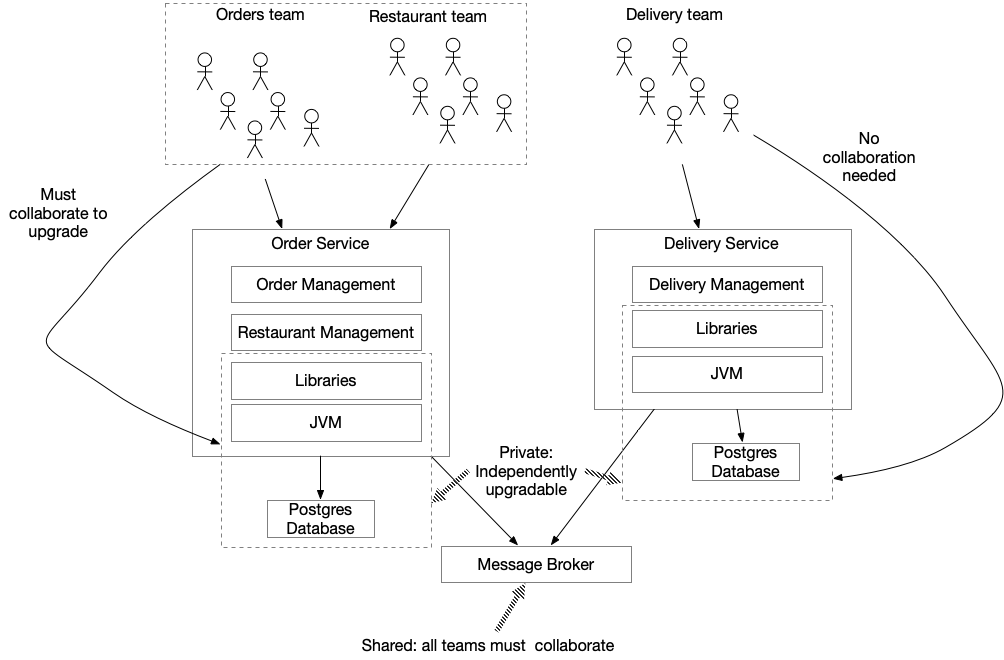
Compare the scope of upgrades to private component technologies with upgrades to shared technologies. section 5.3.4
Independence has a cost: a library used by every component must be upgraded separately in each one. Shared technologies, such as a message broker, can still require coordination among many teams. A small monolith built by a small organization can satisfy fast-flow quality attributes well; the coordination problem becomes more acute in large organizations. section 5.3.4 section 6.1.2
Choose component boundaries to support independent decisions and incremental upgrades, not merely to make services small. In a microservice architecture, services can evolve their stacks separately, but excessive fine-grained decomposition can add complexity. section 7.4.1 section 7.1.3


