liveBook · Manning

Exchangeability

As explained in Time Series Forecasting Using Foundation Models

Exchangeability is a probabilistic property under which reordering a collection of observations does not change their joint likelihood.

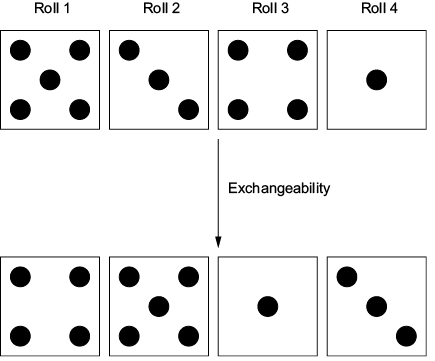
Exchangeability means that reordering a collection of observations leaves the sequence equally likely. Rolling a die illustrates the idea: any ordering of four rolls can be as likely as the original ordering. section 3.2.2

The assumption matters differently across data types:

  • Supports conformal prediction when observations can be reordered without changing their likelihood. section 3.2.2
  • Fails naturally for time series because future observations depend on past observations and timestamps impose an order. section 3.2.2
Figure 3.3 Rolling a die is an example of exchangeability. Here, the die is rolled four times. Rearranging the obtained values gives a sequence that is as likely as the original one.
A diagram of dice with black dots

Description automatically generated

Use the die-roll diagram to compare an exchangeable sequence with an ordered time series. section 3.2.2

How Time Series Forecasting Using Foundation Models covers it

How deep it goes
Defines the property and contrasts die rolls with time series, then points toward adapted conformal methods without fully deriving them.
Examples
Uses four die rolls, website-visit prediction intervals, and ordered daily observations as concrete examples.
What you can do after
Evaluate whether reordering assumptions fit data before applying conformal prediction to produce prediction intervals.
How it connects
Connects exchangeability with conformal prediction, time series, prediction intervals, residuals, and cross-validation.

Related concepts

This explainer was generated by Manning's knowledge graph from the text of Time Series Forecasting Using Foundation Models. The section links point to the parts of the book it draws on.