When a Python program fails inside several nested operations, the execution context stack shows how execution reached the failing line. It records the current call and the underlying operations required to complete it. section 13.1.1
Tracebacks are readable views of this stack. They follow calls from the operation that eventually causes an exception to the operation that raises it directly, preserving the path needed for debugging. section 13.1.1
Use the stack to narrow a traceback:
- Read the traceback from top to bottom; the last call appears at the bottom. section 13.1.4
- Inspect the final call because it directly contributes to the raised exception. section 13.1.4
- Use the reported line and operation to locate the faulty definition, then correct and rerun the code. section 13.1.4
Following a method call to its failure
A Task instance calls update_urgency(4). That method assigns the new urgency and then calls self.update_db(), but the defined helper is _update_db(). The traceback ends at the invalid call and reports that Task has no attribute update_db. Replacing update_db with _update_db makes the script print “update the database”. section 13.1.1 section 13.1.4
Figure 13.1 The execution process of the code in listing 13.1. The first step is defining the Task class. The second step is creating an instance of the class. The third step is calling the update_urgency method. The fourth step is using the method’s definition in the class.
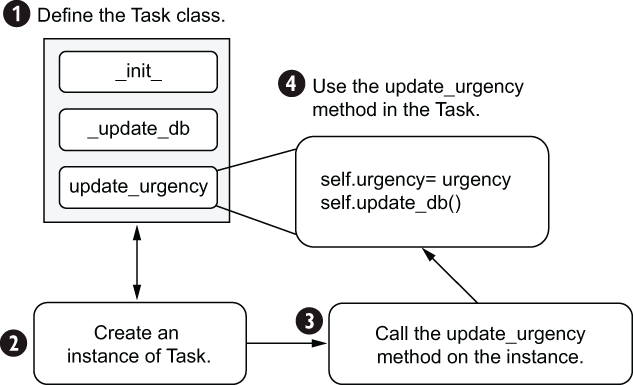
Follow the four-stage execution path from defining the class through creating an instance, calling the method, and using its class definition. section 13.1.1







