An execution policy determines whether an AI-generated action may run in the current business context and workflow state. Unlike content moderation, which filters what the model says, execution policies enforce organization-specific rules such as permissions, prerequisites, regulatory requirements, and approval gates. section 6.6
A Guardrails Service centralizes policy enforcement through operations for input validation, output filtering, policy checks, violation reporting, and policy registration. A policy check evaluates a named policy, proposed action, session or user context, and tool arguments before execution. section 6.6
Apply execution policies as defense in depth across the request lifecycle:
- Validate input for prompt injection, off-topic requests, personally identifiable information, and schema violations. section 6.6
- Check intended tool calls against session state, permissions, business rules, and required prerequisites before execution. section 6.6
- Validate tool arguments against domain constraints and schemas, then filter sensitive or erroneous external responses. section 6.6
- Filter the assembled output for hallucinations, PII, and brand-safety violations before delivery. section 6.6
- Record blocked actions and support shadow mode, canary enforcement, rollback, structured logs, metrics, and audit trails for safe operations. section 6.9
Booking workflow
Before booking an appointment, the system checks whether intake forms are complete, the appointment type is permitted, and any required referral exists. If the policy denies the tool call, the system reports the violation instead of executing it. section 6.6
Figure 6.9 Execution policy guardrails control what the system does, and content guardrails filter what the model says. Both are necessary, but only execution policies can enforce business-specific rules.
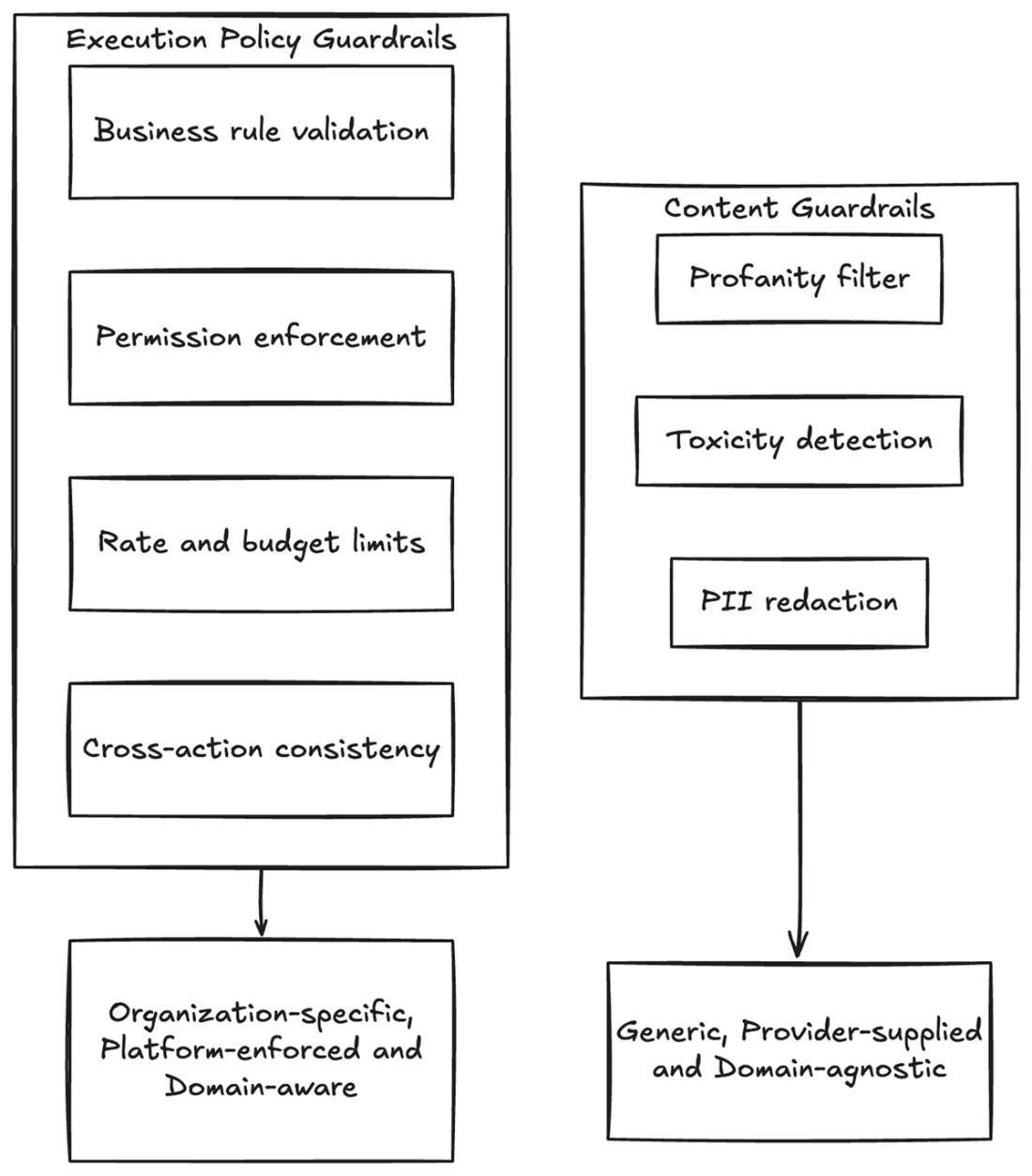
Compare execution-policy guardrails, which control system actions, with content guardrails, which filter model-generated content. section 6.6
Figure 6.10 The five-point inspection model establishes a defense-in-depth architecture for AI interactions. This multi-layered approach ensures comprehensive policy enforcement at every stage of the request lifecycle:(1) Input Validation intercepts malicious prompt injections or off-topic user messages before they reach the model. (2) Pre-Execution Policy evaluates the model's intended tool calls against session state and business rules (e.g., verifying prerequisites are met before booking). (3) Argument Validation ensures the specific parameters sent to external APIs strictly adhere to domain constraints and schemas.(4) External Response Filtering sanitizes sensitive raw data or handles errors returning from external systems before they are incorporated into the AI's context. (5) Output Filtering serves as the final, holistic gate to catch hallucinations, redact PII, and enforce brand safety before the assembled response is delivered to the user.

Inspect the five-point model linking input validation, pre-execution policy, argument validation, external response filtering, and output filtering. section 6.6
