In Monte Carlo tree search (MCTS), expansion grows the search tree one child at a time: from a selected node, try an action not yet represented there and add its child node. Repeating this step builds the tree incrementally instead of exploring every possible route. section 7.5
Expansion sits between selection and simulation in the MCTS cycle:
- Selection navigates the existing tree to a node with unexplored actions; expansion adds one child for an untried action. section 7.5
- Simulation completes a solution from the expanded node, and backpropagation updates statistics along the path to the root. section 7.5
Vehicle routing
When searching for customer routes, expansion adds a child for an action not yet tried at the selected node, gradually extending the route-search tree. section 7.3 section 7.5
Figure 7.4 The four-phase cycle of Monte Carlo Tree Search.
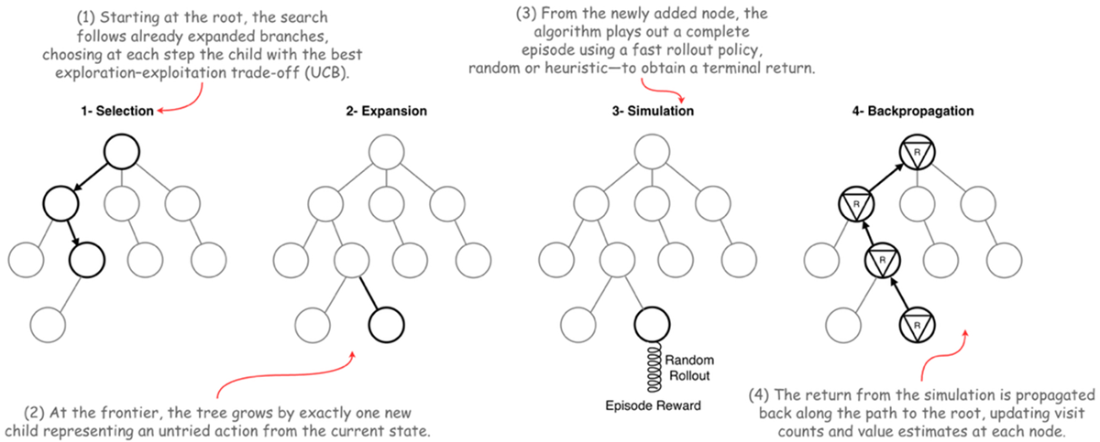
Use the four-phase cycle to see where expansion fits between selection and simulation. section 7.3
