An explainability framework makes AI decision logic inspectable, helping financial institutions address transparency, fairness, and auditability requirements. In credit risk, it supports scrutiny of models processing fragmented or fast-moving signals. section 4.1.3 section 4.3.2
Named methods for unpacking AI logic include:
- SHAP (SHapley Additive exPlanations), used to help auditors assess whether models comply with fair-lending laws. section 4.3.2
- LIME (Local Interpretable Model-agnostic Explanations), also used to help auditors assess fair-lending compliance. section 4.3.2
Figure 4.5 In the modeling layer, we see how credit risk modeling is segmented across the pre-loan, in-loan, and post-loan phases. Fraud detection, limit assignment, and application scoring guide decisions before credit is granted. Behavioral and early-warning models monitor borrower performance once the loan is active. Post- loan models optimize collections strategies and restructuring. MLOps frameworks (e.g., MLflow, Kubeflow) standardize versioning and deployment, while explainability tools (SHAP, LIME) help meet fair-lending and audit requirements.
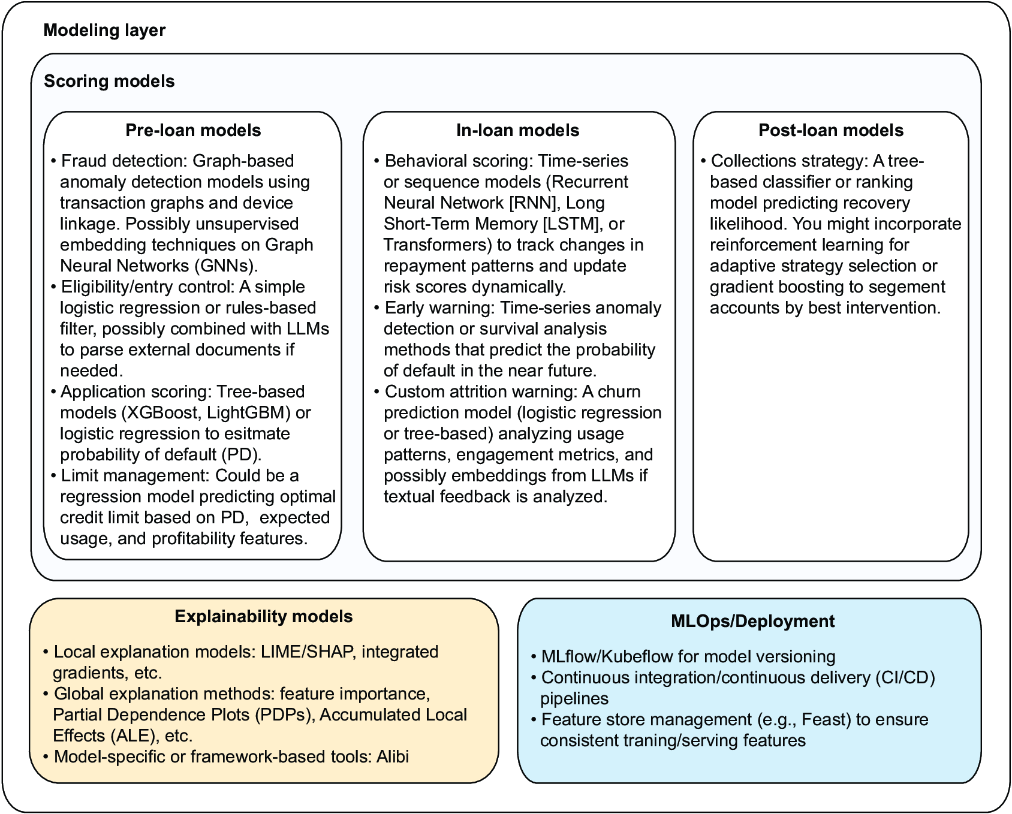
The modeling-layer figure places explainability tools alongside credit models across the pre-loan, in-loan, and post-loan phases, and distinguishes them from MLOps functions. section 4.3.2
