An explainable boosted machine (EBM) is a glass-box ensemble built to make predictions and explanations part of the same model. Rather than train a black box and explain it afterward, an EBM represents a prediction as a sum of nonlinear effects from individual features plus a small set of important feature pairs. Each learned component can be inspected directly for global behavior or for its contribution to one prediction. section 9.5 section 9.5.1
The additive structure starts with a generalized additive model (GAM): each feature gets its own nonlinear function. An EBM extends that structure with selected two-feature functions, rather than every possible pair. Limiting interactions avoids model bloat while retaining interactions the model finds effectual; because every component depends on only one or two variables, its relationship to the target is directly visualizable. section 9.5.1
Training proceeds in two stages:
- Cycle through features repeatedly, fitting one shallow tree component per feature on each pass. Very low learning rates and many iterations gradually learn nonlinear single-feature effects. section 9.5.1 section 9.5.1
- Repeat a similar cyclic procedure for selected pairwise interactions, adding only a small number of interaction components to the additive model. section 9.5 section 9.5.1
- Sum the learned component scores to obtain a prediction; inspect those same scores as positive or negative feature and interaction contributions for an individual example. section 9.5 section 9.5.2
Figure 9.21 An EBM is a generalized additive model consisting of nonlinear components that depend on only one feature as well as nonlinear components that depend on pairs of features. This example shows an EBM for diabetes diagnosis dependent on three variables: age, glc, and bmi. Though there are three pairs of variables (age-glc, glc-bmi, age-bmi), this EBM includes only one of them that it has deemed significant. The explainable boosting model is also an ensemble.
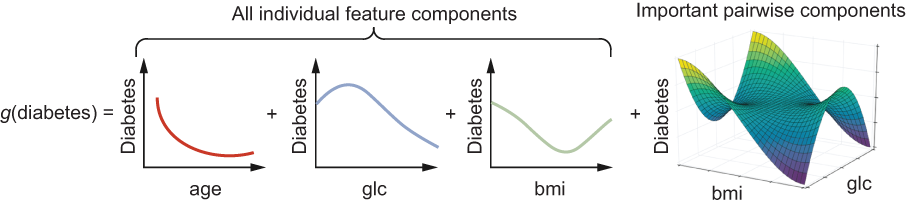
This diabetes-diagnosis layout makes the selective-interaction idea concrete: age, blood glucose, and BMI each have individual components, while only one of three possible feature pairs is retained. section 9.5.1
Figure 9.22 The first stage of the training procedure for EBMs, where models for each feature are trained sequentially and cyclically, with one model per feature per iteration. The trees trained are shallow, and the learning rate is very low. However, over a very large number of iterations, a sufficiently complex nonlinear model for each feature can be learned. A similar procedure is also followed for the second stage of training EBMs, where models for pairwise feature interactions are trained.
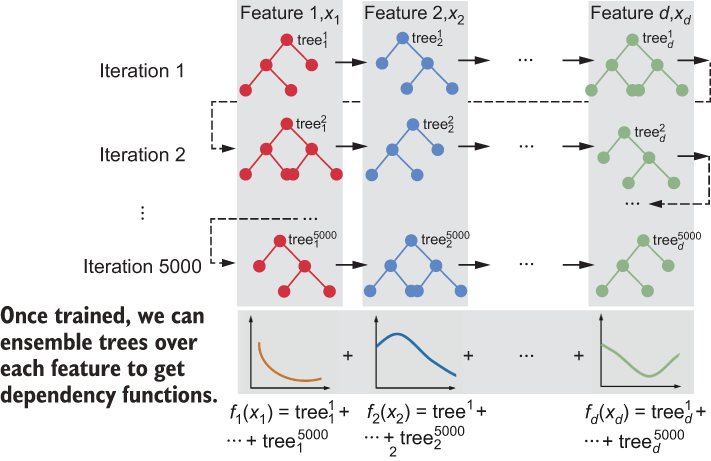
The training diagram shows why EBMs can remain interpretable despite many boosting rounds: shallow trees are assigned cyclically to named feature or interaction components instead of forming one opaque ensemble. section 9.5.1
Bank marketing classification with InterpretML
InterpretML provides ExplainableBoostingClassifier for training, visualization, and interpretation. For imbalanced bank-marketing data, positive examples receive weight 5.0 and negative examples weight 1.0. With 19 features, the classifier considers 171 possible pairs but selects the top 10 by default. The reported EBM achieves 86.69% accuracy and 74.59% balanced accuracy, close to the cited XGBoost result, while exposing local contributions and global feature-importance and dependency views. section 9.5.2 section 9.5.2
