Explicit user consent is a resource owner’s clear approval for a client application to access resources or act on the owner’s behalf. In an interactive authorization flow, the user authenticates and then grants access. section 8.4.1
Consent connects identity to permission: the authorization server asks whether the client may access the user’s data, then redirects the user back with an authorization code. Machine-to-machine integrations usually avoid an interactive consent step by defining permissions when registering the client. section 7.4.3 section 8.4.1
Automated publishing
A user registers an application to publish LinkedIn posts on a schedule and consents to let it act on their behalf. A server using Auth0 instead redirects the user to login, requests consent, receives an authorization code, and exchanges it for an access token. section 7.4.3 section 8.4.1
Figure 8.3 Flow of requests involved in obtaining an access token. The process begins with the user visiting the server’s login page. The API redirects the client to Auth0’s login screen, where the user authenticates and grants consent; then the user is redirected back to the API with the authorization code, which is finally exchanged for an access token.
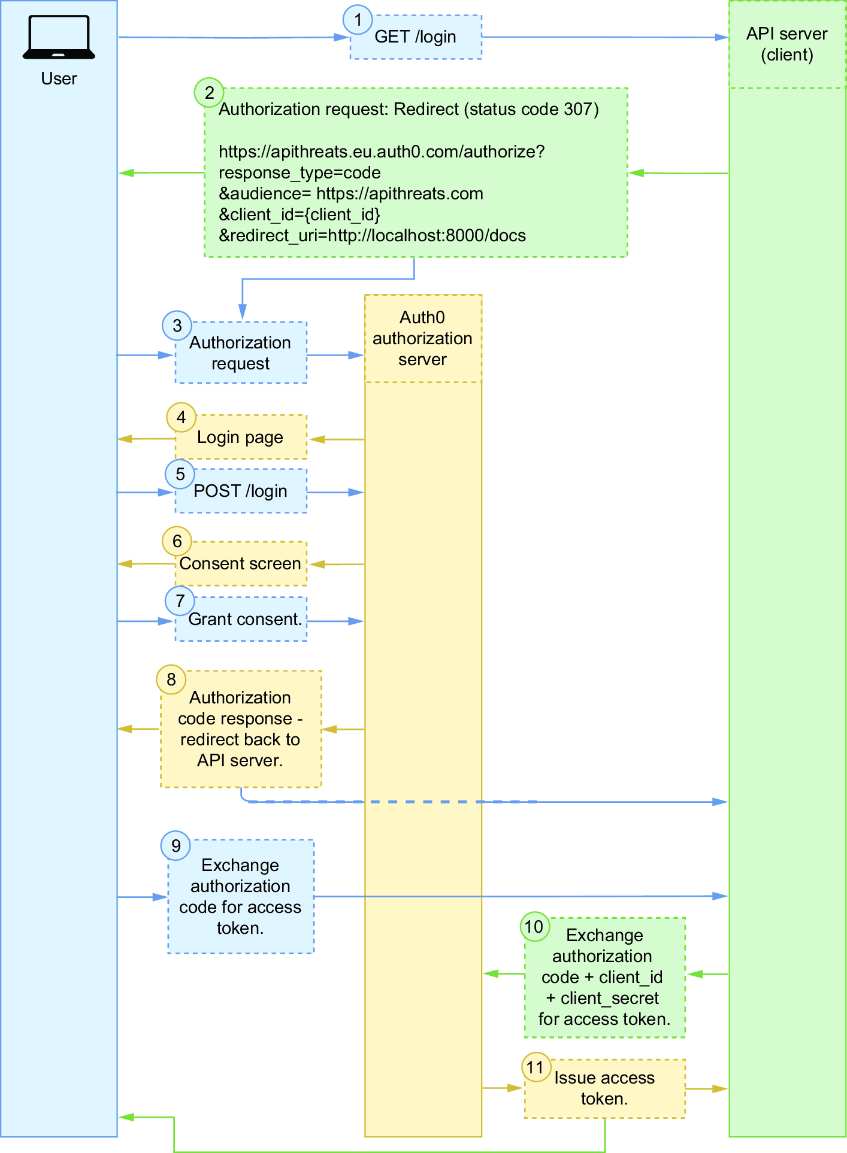
Follow the request sequence from login and consent through redirection with an authorization code and access-token exchange. section 8.4.1



