An exploding gradient is a training failure in which gradient components become exceptionally large as signals pass through successive layers that magnify them. The risk increases as networks become deeper or more complex, because backpropagated loss is repeatedly transformed across layers. section 1.3.1
Common responses include:
- Normalize input data and intermediate layer values to keep signals controlled as they move through the network. section 1.3.1
- Use BatchNormalization between layers; it centers feature-map values around zero by subtracting their mean and dividing by their standard deviation. section 8.1.4
- Treat normalization and dropout as added complexity rather than free fixes: they increase computational requirements, and normalization can smooth important data features. section 1.3.1
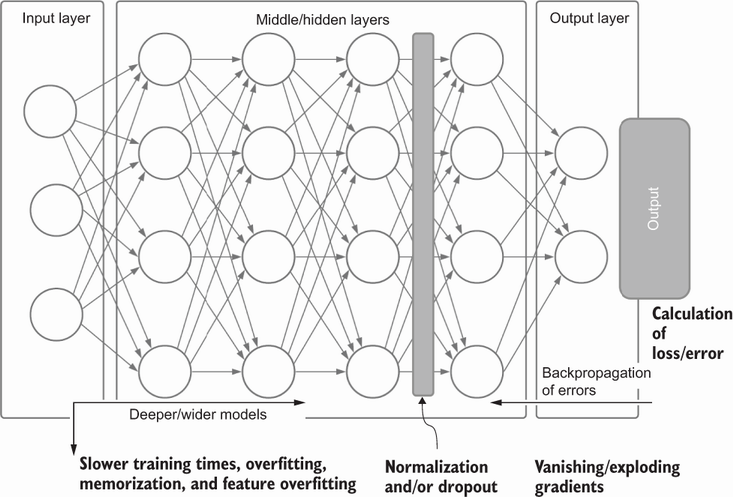
Use the figure to compare exploding gradients with vanishing gradients and other problems that appear as deep-learning systems grow. section 1.3.1
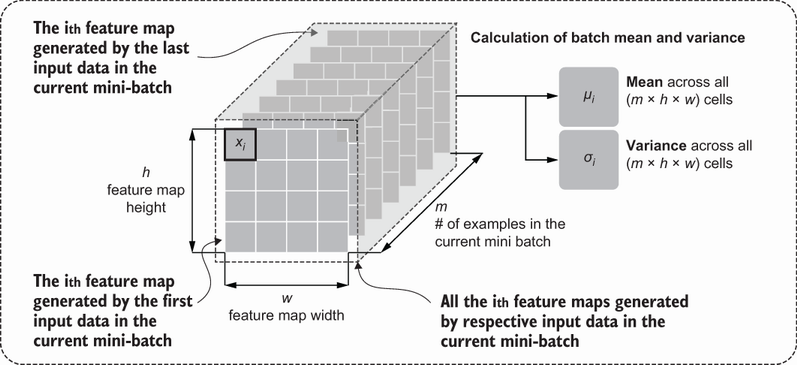
Use the figure to inspect how BatchNormalization calculates feature-map means and variances before passing values to the next layer. section 8.1.4




