A finite field with p elements has an extension of degree k when the extension contains p^k elements. The exponent k counts the coefficient positions in a polynomial representation over the base field. section 7.1
Represent each extension element as a polynomial a₀ + a₁x + ··· + aₖ₋₁xᵏ⁻¹, with every coefficient reduced modulo p. Addition and subtraction operate independently on matching powers. section 7.1
A degree-three extension
For p = 1187 and k = 3, the base field has 1187 elements and the extension has 1187³ = 1,672,446,203 elements. Each of the three coefficients has 1187 possible values. section 7.1
Use extension degree to organize finite-field implementation:
- Choose an indexing variable such as x or t. section 7.1
- Store k coefficients, each reduced modulo the prime p. section 7.1
- Use an irreducible polynomial to construct a field of the precise size p^k. section 13.1
- For elliptic-curve pairings, select k so p^k is congruent to 1 modulo the relevant prime r; this is the embedding degree condition. section 13.1
Figure 7.1 Finite field extension over prime numbers viewed as a clock (\(p=1187\), \(k=3\))
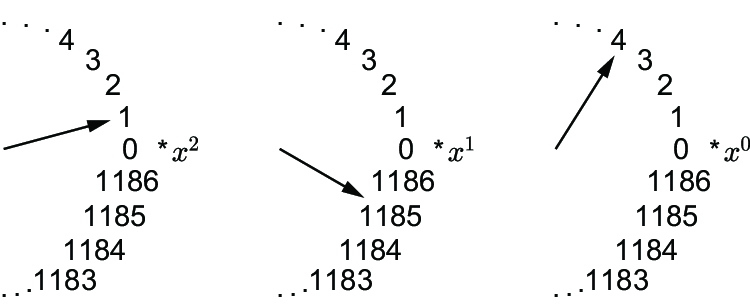
Visualizes the extension as a degree-k structure over the prime field, using p = 1187 and k = 3. section 7.1
