An extrinsic hallucination adds information that the source does not contain or directly imply. In a closed-domain task, it violates source fidelity: the added claim may be plainly false, or may happen to be correct but remain unverifiable from the supplied material. section 5.1.2 section 5.5
Classify the output by contextual grounding and factual alignment:
- Extrinsic but correct: adds a true claim absent from the source, making the response risky because source-based verification cannot establish it. section 5.1.2
- Extrinsic and misaligned: adds a plausible but unsupported or fabricated claim, such as attributing revenue growth to an AI product launch absent from the source. section 5.1.2
- Detect it through claim decomposition and context verification, NLI, LLM-as-a-Judge, or consistency checks such as SelfCheckGPT; consistency alone misses stable errors. section 5.5
Claim-level faithfulness check
Suppose an answer makes six factual claims about an earnings report, but only three appear in the retrieved context. Faithfulness is 3/6 = 0.50, and the three unsupported claims are extrinsic hallucinations. Track this metric to distinguish generation failures from retrieval gaps. section 6.3.1 section 6.5
Figure 5.3 The LLM Reliability Quadrant. Contextual grounding (vertical axis) asks whether the output stays within the provided sources. Factual alignment (horizontal axis) asks if the output is correct according to verifiable evidence. The safest output is both grounded and aligned. The riskiest output is neither grounded nor aligned. The mixed-signal quadrants are operationally important because the output can look based on source but wrong, or look correct but not grounded.
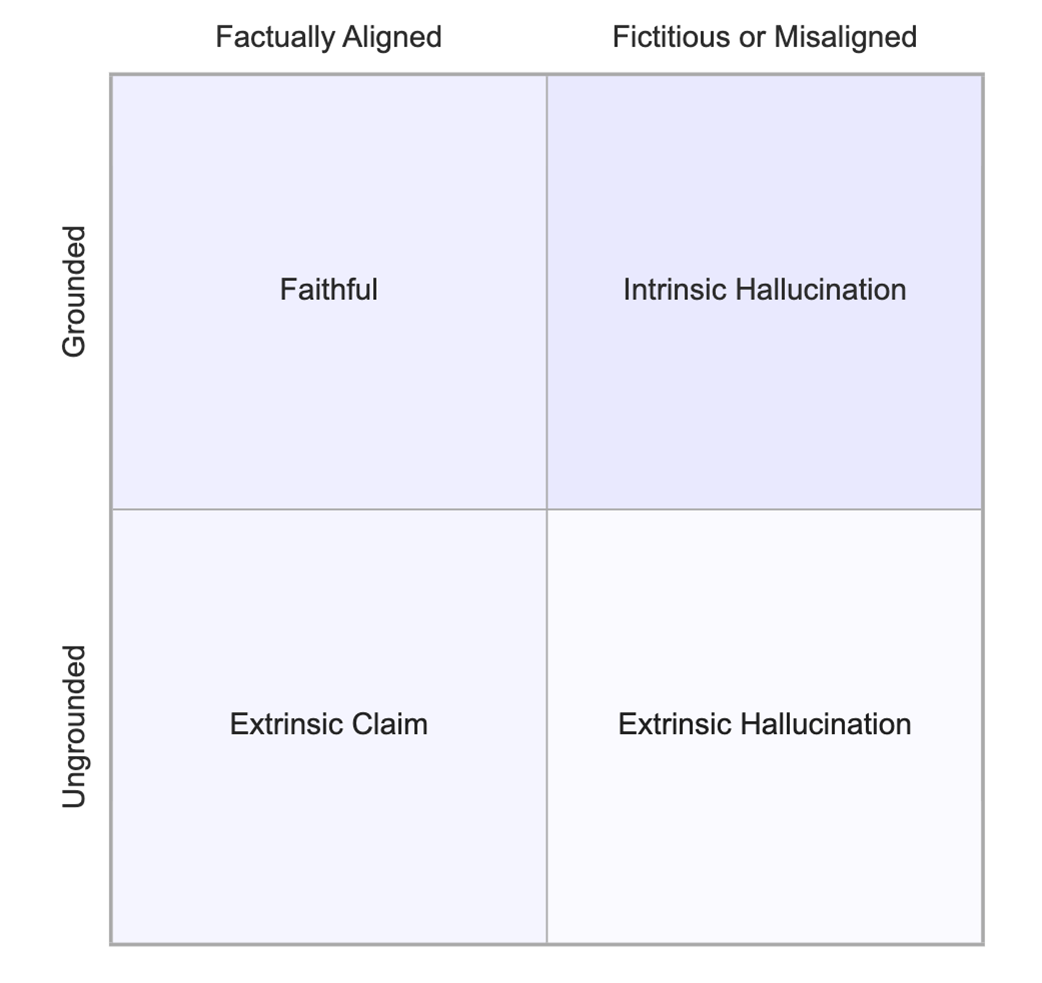
Use the reliability quadrant to compare contextual grounding with factual alignment and identify unsupported generation as a distinct failure mode. section 5.1.2

