A face-centered central composite design (CCD) samples a two-parameter space on a three-by-three grid. In production experiments, it measures markout profit across parameter edges, center, and corners so interpolation can search for an effective combination. section 4.2.1
Trading-parameter experiment
For threshold values 0.5, 1.0, and 1.5 and order sizes 1, 1.5, and 2, the design produces nine settings, including (1.0, 2.0) and all four corners. Measure aggregate markout profit at each setting, then interpolate across the square. section 4.2.1
Figure 4.15 Central composite design (CCD), a design for a 2D RSM experiment. Adding four corner points enables the interpolation to work well across the full area of the square.
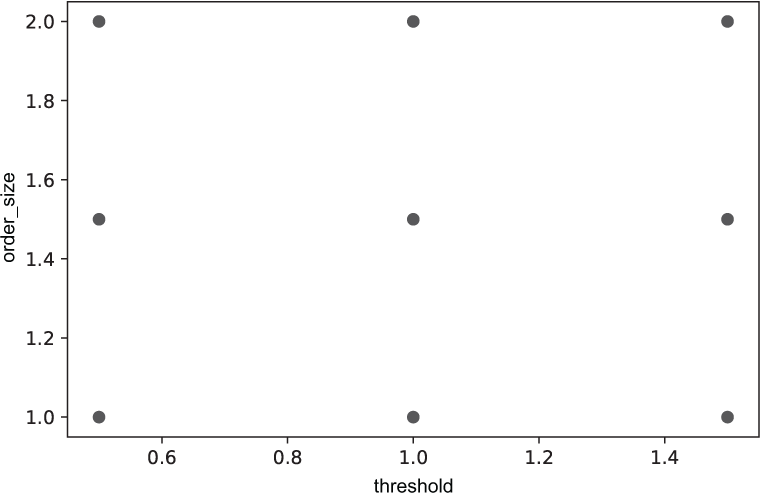
The diagram shows how adding corner points extends interpolation from the edges and center across the full square. section 4.2.1
Generate the design directly from the parameter levels:
- Use the Cartesian product of threshold and order-size values to obtain every planned combination. section 4.2.1
